
AI customer research: how it works and what it changes
AI customer research is the use of AI to do the labor-intensive middle of customer research — transcribing, extracting, clustering, and drafting — so a product team can run continuous research without a research department. Here is what that means in practice, step by step, and where the human judgment still sits.
Automatic transcription
Video and audio transcribed with speaker labels on upload — or let Intervool join the call.
AI insight extraction
Pain points, requests, opportunities, and quotes pulled from each interview, each linked to its moment.
AI theme clustering
What repeats across interviews is grouped into evidence-linked themes you accept, merge, or split.
Personas from real people
Personas and segments built from who you actually interviewed, with every attribute traced to a quote.
Copilot — an AI research assistant
Ask questions across all your research and get answers cited to the interviews they came from.
Prioritized roadmap
Themes become scored feature bets, still one click from the customer behind them.
Interview to insight to roadmap — in one workspace.
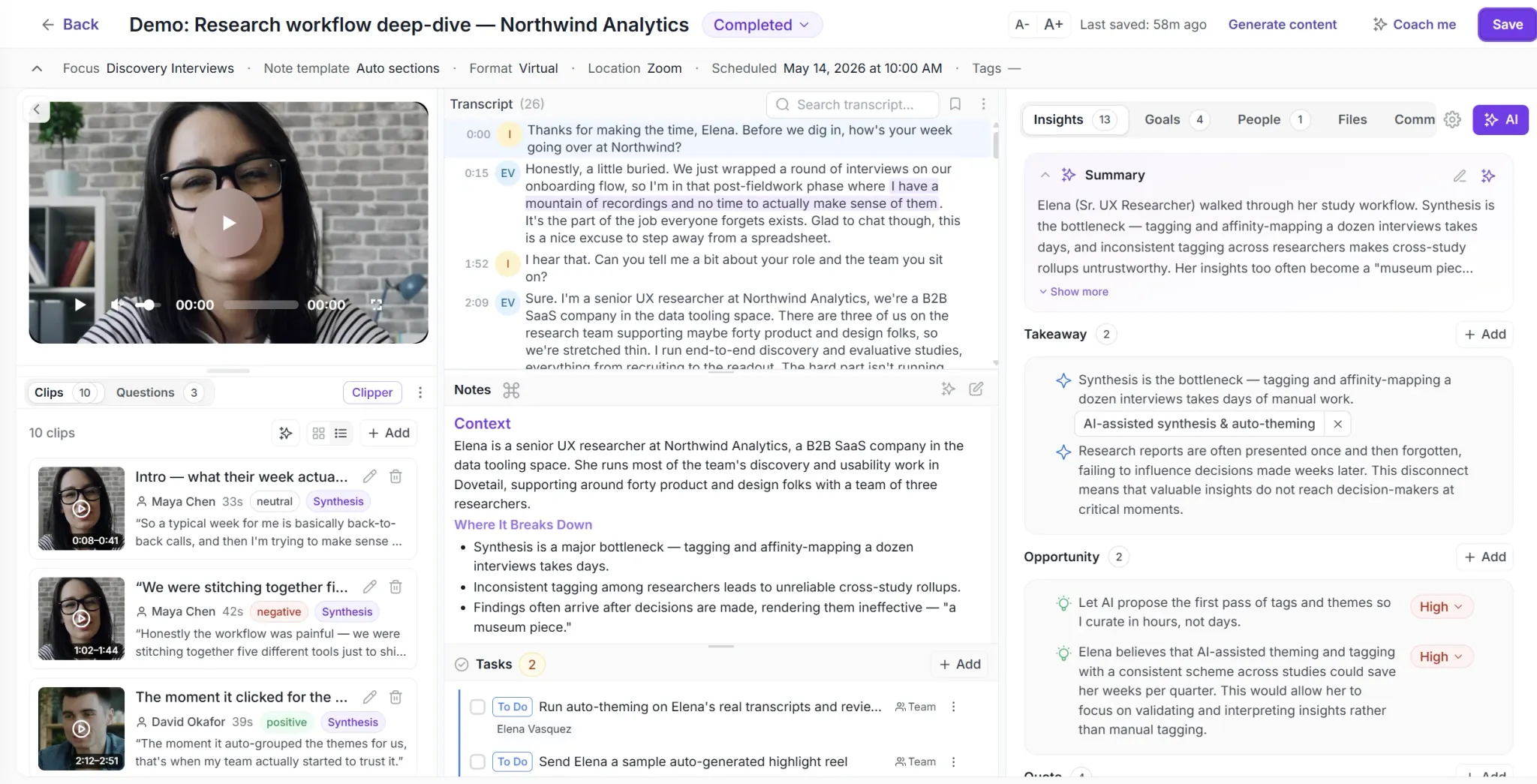
Record or upload, and it's transcribed
Add a call — video, audio, or a recording from months ago — and Intervool produces a speaker-labelled transcript next to the video.
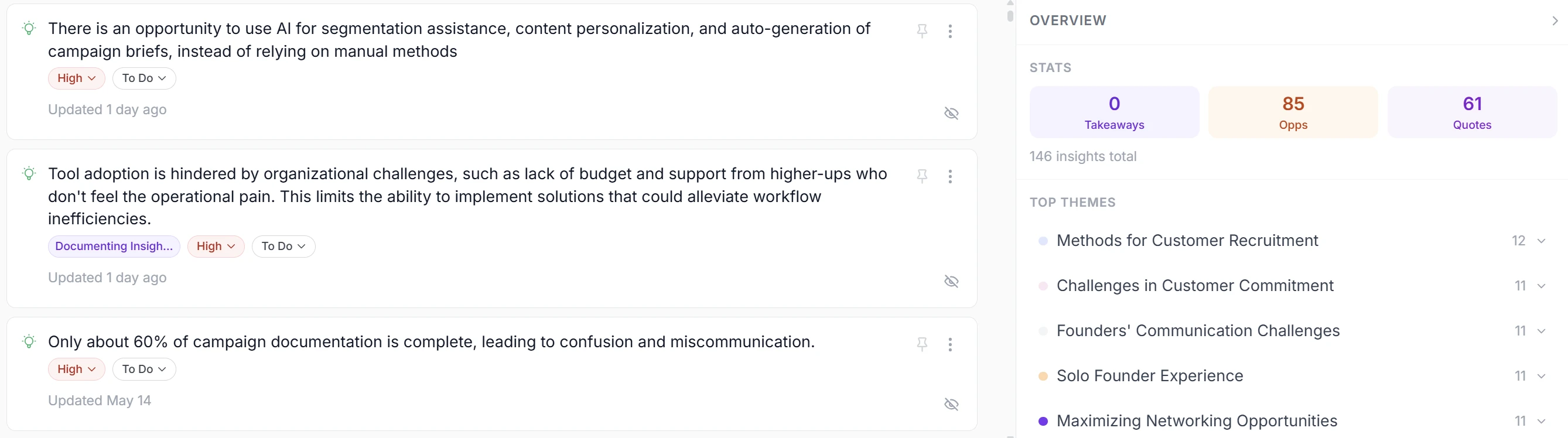
AI pulls the insights, with sources
Pain points, feature requests, opportunities, and quotes are extracted from each interview and linked to the moment they were said.
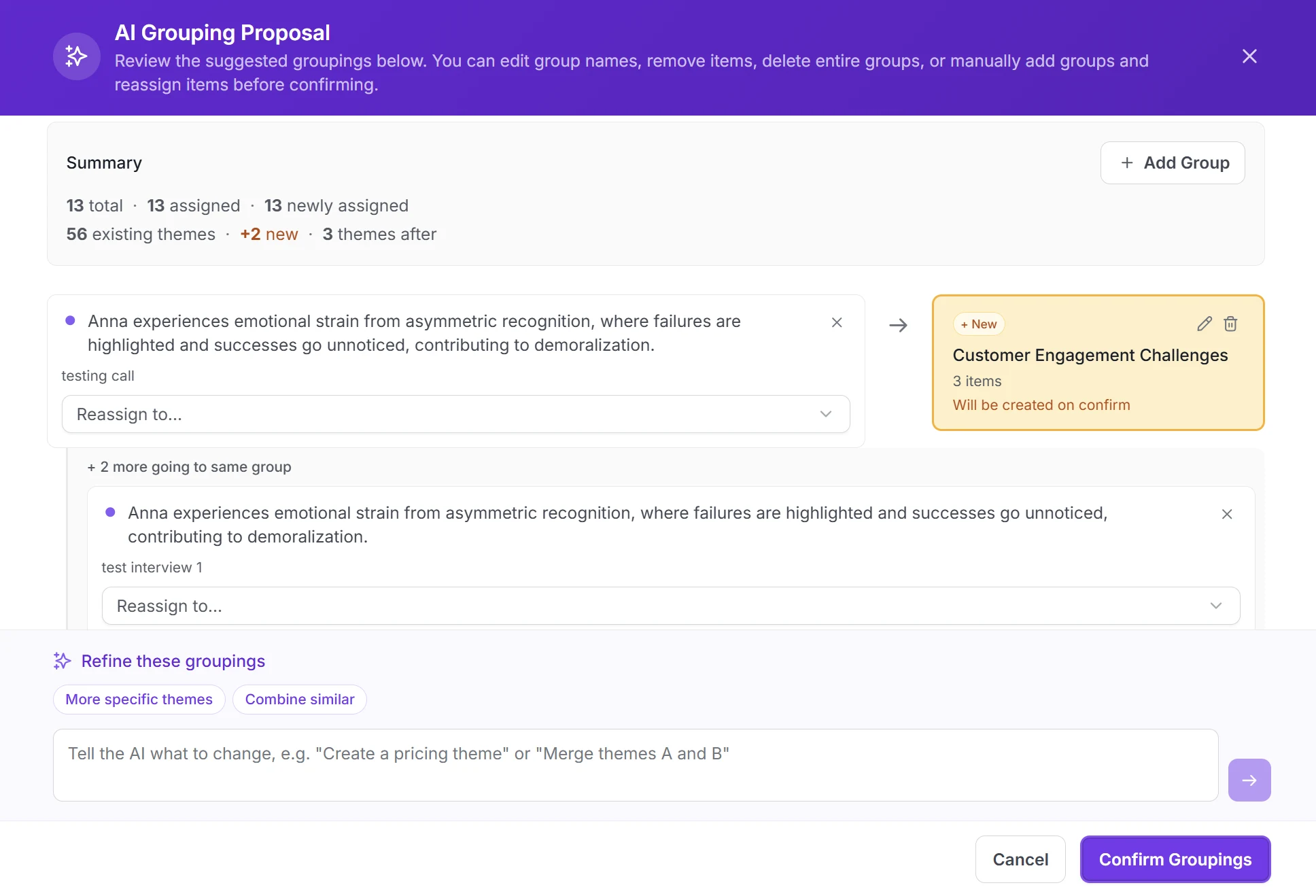
Themes proposed across every call
AI groups what repeats into themes with the evidence attached. You accept, merge, or split — the judgment stays yours.
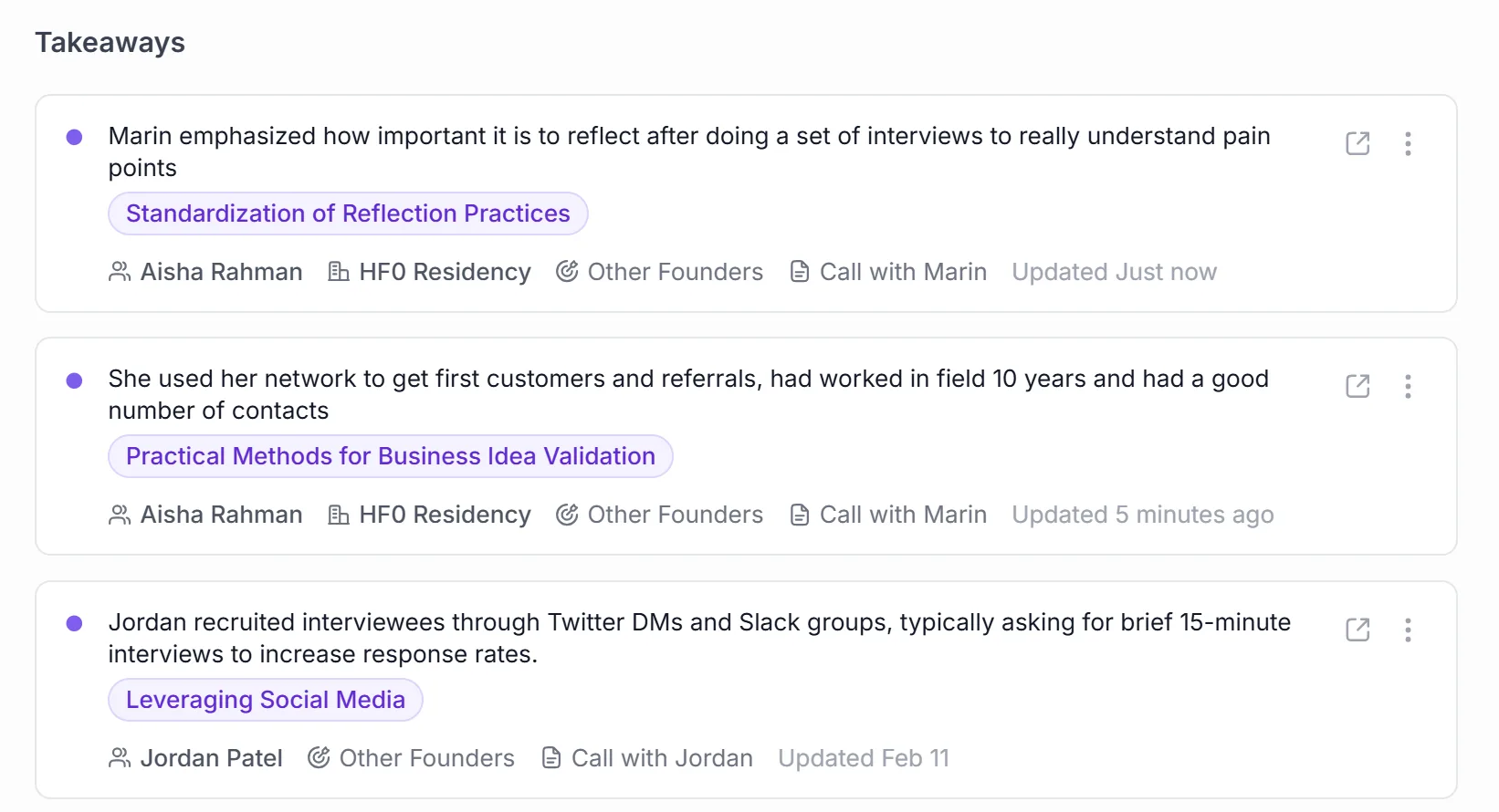
Themes become a roadmap you can defend
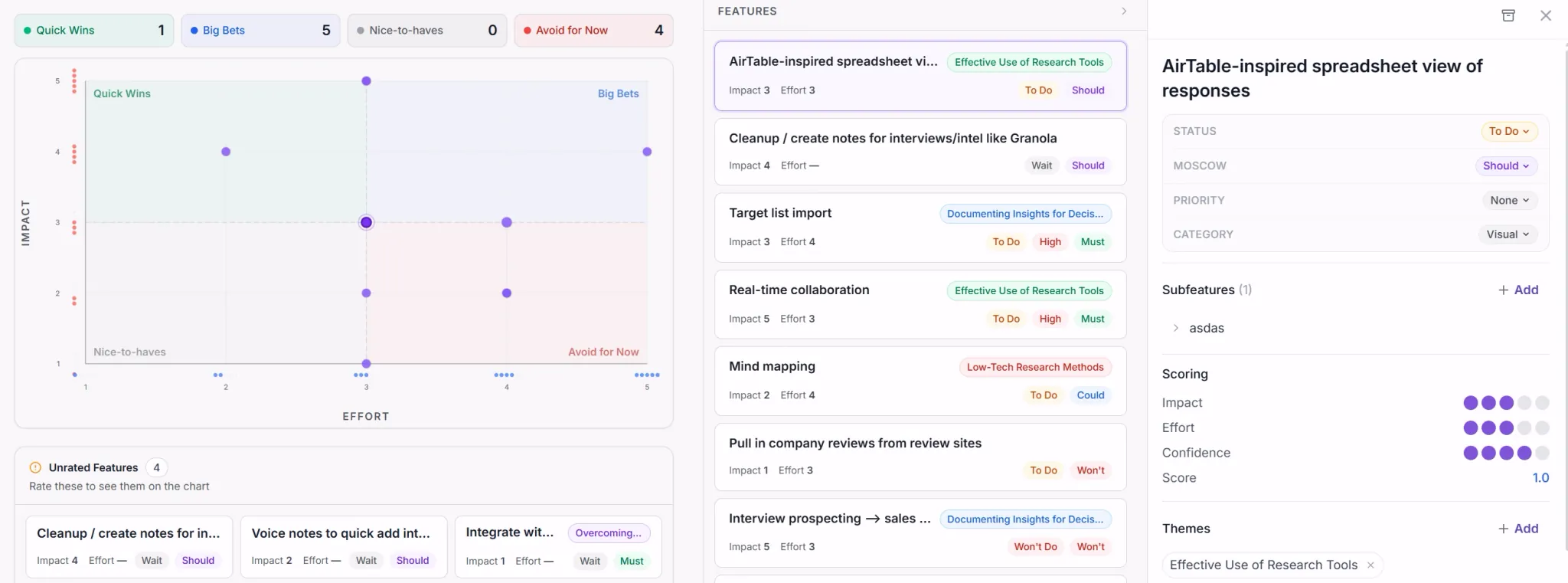
Score themes on impact vs effort and carry them into a roadmap where every priority opens to the customer quote behind it.
Why product teams use Intervool for AI customer research
Every interview gets analyzed
Transcription, insight extraction, and theming happen on upload, so the tenth interview is as well-analyzed as the first.
Every AI claim is checkable
Each insight, theme, and persona attribute links to the exact moment a customer said it — no unsourced summaries.
Patterns across calls, not per call
AI proposes themes across the whole workspace, which is the part humans run out of time for.
Research reaches the roadmap
Themes carry into an impact-vs-effort roadmap in the same tool, so the research changes what gets built.
What is AI customer research?
AI customer research is customer research — interviews, feedback, calls — in which AI handles the mechanical stages: turning recordings into transcripts, pulling structured findings out of them, spotting what repeats across many conversations, and drafting the outputs (themes, personas, summaries) that a researcher would otherwise write by hand. The research questions, the conversations themselves, and the decisions about what the findings mean stay with people.
The reason it matters is time, not novelty. A 45-minute interview has always cost two to three hours to analyze properly, which is why most product teams analyze the interviews they have time for and forget the rest. When the analysis cost drops to minutes, a team can afford to learn from every conversation — and research stops being a quarterly project and becomes something that runs alongside shipping.
Who uses AI customer research
Founders
Run discovery yourself and have the synthesis done by the time the call ends — without hiring a researcher.
Product managers
Turn every customer call into evidence, and every roadmap argument into a quote you can play.
UX & user researchers
Hand the coding and clustering to AI, keep the judgment, and analyze ten times the interviews.
Simple pricing, 14-day free trial
Every plan includes the AI: transcription, insight extraction, theme clustering, personas, Copilot, and the roadmap.
For solo founders and individual PMs running their own research.
6 seats included. For product teams doing continuous research together.
No credit card to start. AI usage is included in the plan — there is no per-interview or per-token charge.
Comparing your options?
See how Intervool stacks up against research repositories like Dovetail, Condens, and Marvin.
What AI does at each step of customer research
Recruiting. AI helps least here. It can draft screeners and outreach and rank a list against an ideal customer profile, but the decision about who to talk to is a research-design decision, and recruiting still runs on email and incentives. Treat AI as a drafting assistant at this stage.
Interviewing. Two very different things get called AI interviews. AI-moderated tools conduct the conversation themselves — useful for validating a known question with hundreds of people, weak at the unexpected follow-up. AI notetakers join your call and record it. Most product teams want the second, and want the recording to flow into analysis rather than into a summary email. See the best AI customer interview tools for both kinds.
Transcribing. Solved. Speaker-labelled, timestamped transcripts in minutes, at accuracy a quick review makes publishable. This is the step that made everything after it possible.
Extracting. AI reads each transcript for the structured findings a researcher would tag by hand — pain points, requests, workarounds, quotes — and attaches each to its timestamp. This is the exhaustive, mechanical work that used to consume the analysis budget, and AI does it on every interview, not just the ones there was time for.
Synthesizing. AI proposes the patterns across many interviews: which findings repeat, from whom, how strongly. This is where the leverage is, because cross-interview synthesis is the step humans skip when they are busy. It is also where judgment matters most — a proposed theme is a hypothesis until a person confirms the quotes actually support it.
Drafting outputs. Personas, segment profiles, summaries, and a first cut of a prioritized roadmap can all be drafted from the synthesized themes. The best tools keep every generated sentence linked to its evidence so the draft can be checked, not just read.
What AI customer research does not do
It does not decide what to research. A tool cannot tell you which decision matters this quarter or which customers to learn from; a vague question in produces a confident, useless answer out.
It does not replace the conversation. The interview is where the surprises happen, and the follow-up question a person asks because something in the tone changed is still the highest-value moment in research. AI moderators are getting better; they are not there for discovery.
It does not know when it is wrong. An AI-proposed theme can be a resemblance rather than a pattern, or three loud quotes from one segment. That is why evidence linking is the non-negotiable feature: if you cannot open a theme and see the customers behind it, you cannot trust it.
It does not make the decision. Research informs; someone still has to choose what to build and own the call. AI customer research shortens the distance between a customer saying something and a team deciding what to do about it. It does not remove the deciding.
AI research assistant: what to expect from one
An AI research assistant is the conversational layer over a body of research — you ask a question in plain language and it answers from your interviews, transcripts, and findings. The useful ones are grounded and cited: ask what enterprise customers said about onboarding and you get an answer with the specific quotes, people, and calls it came from, so you can verify it in one click. The dangerous ones are fluent and unsourced; they will answer any question, including ones your research cannot support.
Intervool's Copilot is the grounded kind. It searches across every interview in the workspace, not just the one you are looking at, and every answer links to the interview, quote, or theme it drew on. That makes it useful for the questions that come up between studies — what did we hear about pricing, which segment complained about exports, is there evidence for this feature request — without a researcher re-reading transcripts to answer them. See the AI insights feature for how it works, and the best AI UX research tools for how other platforms approach it.
How to start with AI customer research
Upload what you already have. Most teams are sitting on months of recorded calls nobody analyzed. Adding ten of them to a tool that extracts and themes automatically produces a first set of evidence-backed themes in an afternoon and shows you immediately whether the approach is worth your time.
Keep the human steps human. Write real research questions, run the interviews yourself, and review every proposed theme against its quotes before it goes anywhere near a roadmap. AI is at its best when it replaces reading, not thinking.
Pick a tool by where the findings end up. If the output is a report, a repository with AI summaries is enough. If the output is a decision about what to build, choose a tool that carries themes into prioritization — otherwise the last mile is still a spreadsheet. The best AI notetakers for customer interviews guide covers the capture-only end of the market; what is Intervool shows the interview-to-roadmap loop end to end.
Common questions.
What is AI customer research?
Customer research — interviews, calls, feedback — where AI handles the mechanical stages: transcribing recordings, extracting pain points and quotes, clustering what repeats across conversations into themes, and drafting outputs like personas and summaries. People still choose the questions, run the conversations, and judge what the findings mean.
What is an AI research assistant?
A conversational layer over a body of research that answers questions in plain language from your interviews and findings. A good one is grounded and cited — every answer links to the quotes and calls it came from — so it can be verified. Intervool's Copilot works this way across every interview in a workspace.
Can AI conduct customer interviews?
AI-moderated interview tools can run a structured conversation with many participants at once and are useful for validating a known question at volume. For discovery, where the value is in the unexpected follow-up, human-led interviews with AI doing the analysis afterwards produce better research.
Is AI customer research accurate?
Transcription and extraction are accurate enough that a quick review makes them reliable. Synthesis — the themes AI proposes across interviews — should be treated as hypotheses until a person checks the quotes behind them. The feature that makes accuracy checkable is evidence linking: every claim opens to its source.
Does AI customer research replace a UX researcher?
No. It replaces the reading, tagging, and clustering that consumed a researcher's time, which means a team without a researcher can now do useful research and a team with one can analyze far more. Designing studies, asking good questions, and judging findings remain human work.
How much does AI customer research software cost?
Intervool includes all AI features — transcription, extraction, theming, personas, Copilot, and the roadmap — at $39/month for Basic and $279/month for Team with six seats, with a 14-day free trial and no per-interview charge. Repository tools with AI add-ons typically price per seat; AI-moderated interview platforms price per completed interview.
What is the difference between AI customer research and a research repository?
A repository stores, tags, and searches research; AI features on top summarize what is there. AI customer research is the whole workflow — from recording to a decision — with AI doing the analysis stages. Intervool is built as the latter and includes the repository as one part of it.
Turn customer conversations into decisions.
Try Intervool free for 14 days. No credit card required.