
Product Roadmapping: The Complete Guide
What product roadmapping actually is, the roadmap formats that work, how to build one step by step, the prioritization frameworks worth knowing — and the mistakes that turn roadmaps into fiction.
14-day free trial · No credit card · Cancel anytime
Keep your product roadmap in Intervool
A roadmap in a slide deck is stale the day after planning, and nobody can trace an item back to the customer who asked for it. Intervool keeps the research and the roadmap in the same workspace — so the plan updates as you learn, and every item carries its evidence.
- Store every customer interview, recorded and transcribed automatically
- Synthesize conversations into evidence-linked themes
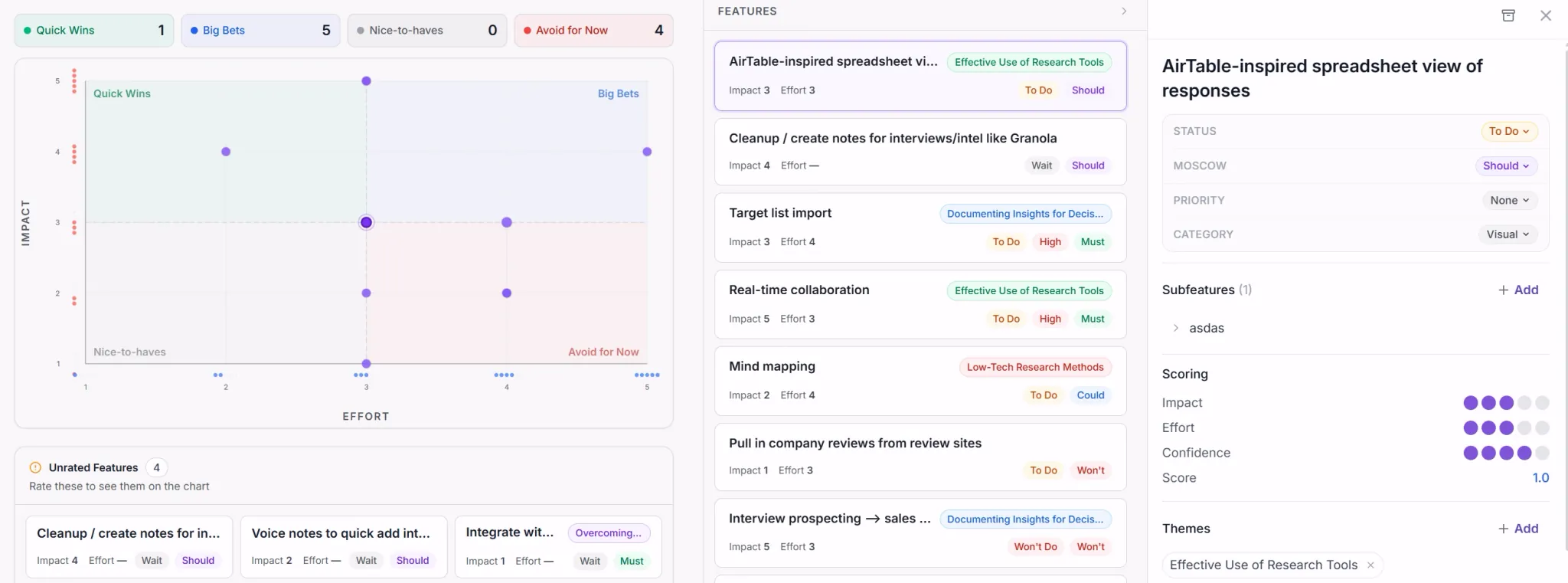
- Score bets on impact vs effort, RICE, or MoSCoW — in the open
- Render now/next/later and MoSCoW roadmap views for stakeholders
- Click any roadmap item straight through to the quote behind it
What is product roadmapping?
Product roadmapping is the practice of deciding, prioritizing, and communicating what a product team will build and why. The output is the product roadmap — a visual, living document that connects customer evidence and business goals to a sequenced plan.
A good roadmap does three jobs at once. It aligns the team and stakeholders on direction, so everyone understands not just what's being built but the reasoning behind it. It forces prioritization — putting one thing in "now" means putting everything else in "later" or "never," and making that trade-off explicit. And it communicates intent without false certainty: a roadmap is a statement of current strategy, not a delivery contract.
The most important thing to understand about roadmapping is that the roadmap itself is the easy part. Any tool — a slide, a spreadsheet, a board — can draw the boxes. The hard part is what feeds it: knowing which customer problems are real, widespread, and worth solving. That's why the strongest roadmapping practices start from customer research, not from a brainstorm.
Roadmap vs strategy vs backlog vs release plan
These four artifacts get conflated constantly. They stack like this:
| Artifact | Question it answers | Horizon |
|---|---|---|
| Product strategy | Where are we going, for whom, and why will we win? | Years |
| Product roadmap | What are we building toward that strategy, in what order, and why? | Months to quarters |
| Backlog | Exactly what work comes next? | Weeks |
| Release plan | What ships, when, and how do we tell people? | A release |
The roadmap is the hinge between strategy and execution. When it degenerates into a giant backlog with dates, it stops doing its real job — communicating priorities and the evidence behind them.
The main types of product roadmaps
Format matters less than most teams think — but the format you present shapes what stakeholders expect. Most teams keep one prioritized source of truth and render different views for different audiences.
Now / Next / Later
Three sequenced buckets, no dates. 'Now' is committed and in progress, 'Next' is prioritized and likely, 'Later' is directional. The best default for most teams: it communicates priority honestly without manufacturing deadline certainty. Popularized by ProdPad.
Best for: Default choice for startups and agile product teams
Outcome- or theme-based
Organized around customer problems or business outcomes ('reduce onboarding drop-off') rather than features. Keeps the team solution-flexible and ties every lane of work to a why. Pairs naturally with research-driven prioritization, since themes come straight from synthesized customer evidence.
Best for: Teams that want strategy, not a feature list
Timeline / Gantt
Features on a calendar, often with swimlanes per team. Sometimes unavoidable — enterprise sales, compliance deadlines, coordinated launches — but the format invites stakeholders to read estimates as commitments, and it ages the fastest.
Best for: Enterprise contexts with genuine date commitments
MoSCoW board
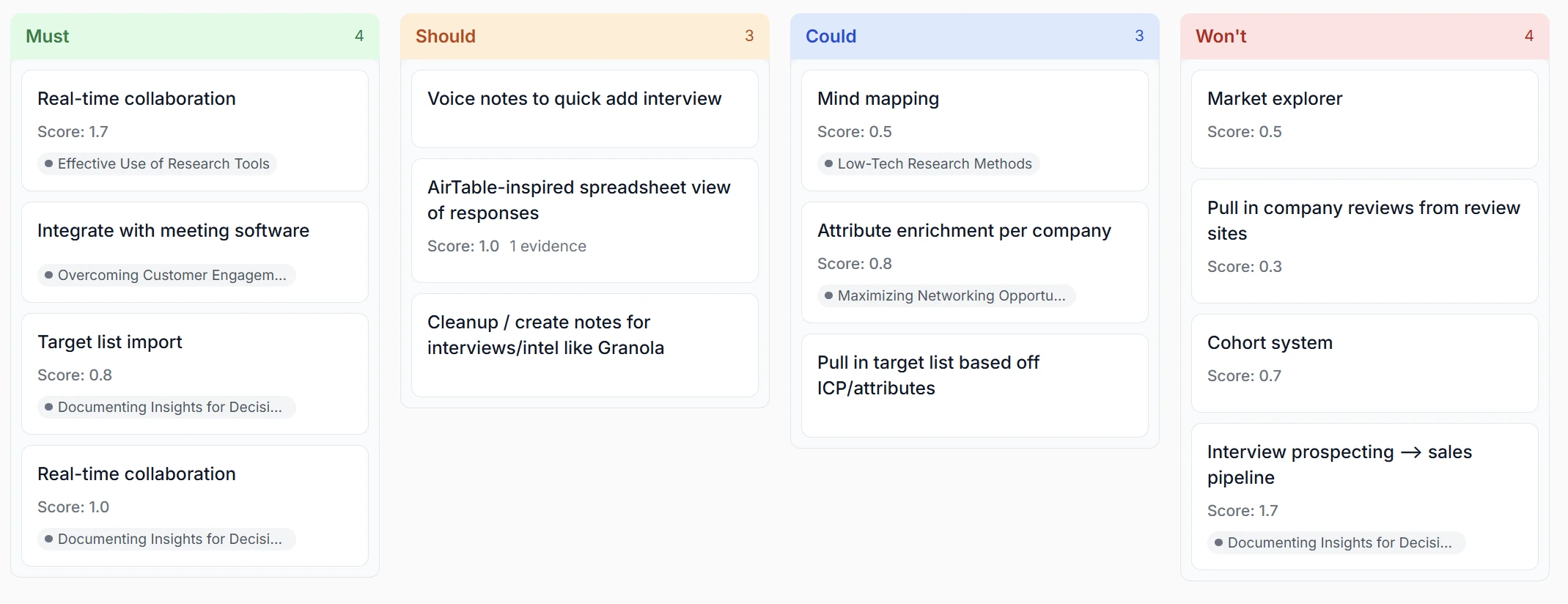
Must have, Should have, Could have, Won't have. A necessity lens rendered as a roadmap: which workflows the product genuinely has to support (Must), which are nice-to-haves you could do (Should, Could), and what you're just not able to build right now (Won't). Intervool renders this view directly from your prioritized features.
Best for: Separating what the product needs from what would merely be nice
Product roadmap examples
Three roadmaps for the same fictional product — a B2B analytics tool whose customers keep rebuilding the same weekly report by hand — rendered in the three formats above. Same evidence, same priorities, different audience.
Now / Next / Later
For: The engineering team and weekly product sync
- Now
- Scheduled report export (5 of 8 interviews)Fix import file-type confusion (trial drop-off)
- Next
- Change summary email — 'what moved this week'Shared dashboards for ops leads
- Later
- Slack digestForecasting — needs more evidence
No dates, so nothing is promised that research hasn't earned yet. Each 'Now' item names its evidence count, which is what makes the order defensible.
Outcome-based
For: Leadership and the quarterly planning review
- Cut weekly reporting time for ops leads by half
- Scheduled exportChange summaryShared dashboards
- Lift trial → paid from 12% to 18%
- Import file-type fixFirst-report onboarding
- Exploring
- Forecasting (3 requests, 1 segment)
Features are grouped under the customer outcome they serve, so the conversation is about whether the outcome matters — not whether a feature is 'done'.
MoSCoW board
For: Scoping a release with sales and support in the room
- Must
- Scheduled exportImport fix
- Should
- Change summary email
- Could
- Shared dashboardsSlack digest
- Won't (this release)
- ForecastingCustom branding — 1 request
The 'Won't' column is the point. Writing down what is not happening, with the reason, ends the hallway relitigation that timeline roadmaps invite.
Notice what all three share: the items came from customer interviews, and the count of interviews behind each one is visible. That is the difference between a roadmap and a wish list — see evidence-based product roadmaps for how to get there.
How to build a product roadmap, step by step
The condensed version — the full walkthrough lives in How to build a product roadmap.
- 1
Start from evidence, not ideas
Gather what you actually know: customer interviews, support themes, sales-call patterns, usage data. If the inputs are thin, run discovery interviews first — a roadmap built on assumptions is a to-do list wearing a strategy costume. How to conduct customer interviews covers the front half of this.
- 2
Synthesize into themes
Cluster what repeats across conversations into evidence-linked themes — the recurring problems, not one-off requests. This is the step most teams skip, and it's why their roadmaps fill with whatever the loudest customer asked for last. Synthesizing conversations into themes goes deeper.
- 3
Frame themes as problems worth solving
For each theme, capture who has the problem (which segments), how often it appears, and the evidence behind it. Themes with breadth across your target segments outrank passionate one-offs.
- 4
Generate candidate bets
Turn the top problems into candidate features or initiatives. Keep them at bet altitude — "improve import so trials survive day one," not a spec.
- 5
Score with an explicit framework
Impact vs effort, RICE, or MoSCoW — the specific framework matters less than using one consistently, in the open. Explicit scoring turns roadmap fights about opinions into conversations about evidence. Roadmap prioritization compares the options.
- 6
Sequence and choose a view
Order the winners into now/next/later or a MoSCoW board. Add dates only where real commitments exist. Different audiences can get different renderings of the same underlying priorities.
- 7
Keep it alive
Revisit on a cadence — monthly or quarterly — and whenever significant new evidence lands. New interviews should be able to move items; that's the sign the roadmap is connected to learning rather than frozen at planning time.
Prioritization frameworks for roadmapping
Every framework is a structured way to argue about value versus cost. Pick one, use it consistently, and feed it evidence — here's the full comparison.
Impact vs effort
Score each bet on expected customer/business impact against build cost, and plot the 2×2: quick wins, big bets, fill-ins, money pits. The fastest framework to run and the easiest to explain — best default for small teams.
Best for: Startups and lean product teams
RICE
Reach × Impact × Confidence ÷ Effort. Adds two things impact/effort lacks: how many customers a bet touches, and how sure you are. The confidence term is the honest part — it forces you to admit which scores are guesses.
Best for: Teams with usage data and competing stakeholders
MoSCoW
Must, Should, Could, Won't. A necessity test rather than a scoring formula: does the product actually need this workflow, or is it a nice-to-have you could do? The Won't column is equally honest — the things you're not able to build right now, stated openly instead of left to haunt every planning cycle.
Best for: Sorting needed workflows from nice-to-haves
Kano
Classifies features as basic expectations, performance features, or delighters based on how presence/absence affects satisfaction. Heavier to run (it needs structured customer input) but valuable for balancing table-stakes work against differentiation.
Best for: Mature products balancing parity vs delight
The mistakes that sink roadmaps
Building from opinions, not evidence
The roadmap becomes a negotiation between the strongest personalities in the room. The fix is structural: require every item to cite the customer evidence behind it. No evidence, no slot — the evidence-based roadmap explains the practice.
Listening to the loudest customer
One vocal account's requests aren't a pattern. Prioritize themes that repeat across segments — stop building for the loudest customer.
Treating the roadmap as a delivery contract
Once stakeholders read dates as promises, the team optimizes for hitting estimates instead of learning. Communicate horizons and priorities; commit to dates only where a real external commitment exists.
A feature list with no why
If a roadmap item can't be traced to a problem and the people who have it, stakeholders can't evaluate it and the team can't make scope trade-offs intelligently. Theme-based framing fixes this.
Set-and-forget planning
A roadmap frozen at annual planning decays immediately. Continuous discovery should keep moving items — that's a feature of the process, not churn.
Confirmation-bias curation
It's easy to fill a roadmap with evidence for what you already wanted to build. Synthesis across all interviews — including the ones that contradict you — is the guard. Confirmation bias in product management.
The roadmap is only as good as the research behind it
Every framework above assumes you can answer one question honestly: which customer problems are real, widespread, and severe? That answer comes from research, not planning meetings.
Intervool is built for that connection: it captures and transcribes customer interviews, synthesizes them into evidence-linked themes, scores feature bets on impact vs effort, and renders roadmap views where every item stays one click from the customer quote behind it.
That’s the difference between a roadmap you present and a roadmap you can defend: when someone asks “why is this in Now?”, the answer is three customer quotes away, not a memory of a meeting.
Product roadmapping questions
Where should a product team keep its roadmap?
Keep it wherever the evidence lives, so the roadmap and the reasoning behind it never drift apart. Slides and spreadsheets go stale the day after planning and lose the link back to what customers actually said. Intervool keeps interviews, themes, prioritization scores and roadmap views in one workspace, so every item stays one click from the customer quote behind it. It's free for 14 days, no credit card.
What is product roadmapping?
Product roadmapping is the practice of deciding, prioritizing, and communicating what a product team will build and why. The output — the product roadmap — is a living document that connects customer evidence and business goals to a sequenced plan, so teams and stakeholders align on direction without locking into false certainty.
What is the difference between a product roadmap and a backlog?
The roadmap is strategic — it communicates direction, themes, and priorities over a horizon of months or quarters. The backlog is tactical — a granular, ordered list of work items for the near term. The roadmap answers 'why and what, roughly when'; the backlog answers 'exactly what, next'.
What are the main types of product roadmaps?
The most common formats are now-next-later (sequenced buckets without dates), outcome- or theme-based (organized around problems to solve), timeline/Gantt (date-driven, common in enterprise), and MoSCoW boards (Must, Should, Could, Won't). Most teams maintain one source of truth and render different views for different audiences.
How often should a product roadmap be updated?
Review the roadmap on a regular cadence — monthly for fast-moving teams, at least quarterly for everyone else — and any time significant new evidence lands. A roadmap that hasn't changed in six months usually means the team stopped learning, not that the plan was perfect.
Should a product roadmap have dates?
Only where a real commitment exists (a contract, a launch event, a compliance deadline). For everything else, sequenced buckets like now-next-later communicate priority without manufacturing fake certainty — date-driven roadmaps invite stakeholders to read estimates as promises.
What makes a product roadmap defensible?
Evidence. A defensible roadmap lets you walk any stakeholder from a roadmap item back to the customer research behind it — how many customers hit the problem, which segments, and what they actually said. That traceability is what ends opinion-driven roadmap fights.
What tools do teams use for product roadmapping?
It depends on the job: Intervool for turning customer research into a prioritized, evidence-linked roadmap; Productboard or Aha! for enterprise roadmap suites; ProductPlan or ProdPad for lightweight visual roadmaps; Jira Product Discovery or Linear for delivery-linked planning. See our comparison of the best product roadmap tools.
Stop rebuilding the roadmap every quarter
Keep your interviews, themes, prioritization and roadmap in one place — and walk into the next planning meeting with the evidence already attached.
14-day free trial · No credit card · Cancel anytime