
In a fast-moving market, understanding customer needs is everything. Product feedback tools are how teams gather that understanding at scale — collecting user feedback, making sense of it, and turning it into better products and happier customers. The payoff for getting the experience right is real: Qualtrics' XM Institute found 72% of US consumers would pay more for a premium experience — and acting on feedback is how you deliver it.
The category has changed a lot since the early 2020s. In 2026, AI-powered analysis is a baseline expectation, not a premium add-on: the best tools auto-tag themes, detect sentiment, and surface trends from unstructured text — support tickets, call transcripts, app reviews — without anyone reading through it all manually. At the same time, lightweight and focused tends to beat feature-rich-but-complex.
Below is an updated, researched look at the top product feedback tools for 2026, grouped by what they're actually best at — so you can match a tool to your team instead of wading through a flat list.
What Is a Product Feedback Tool?
A product feedback tool is software that helps you collect and analyze customer feedback. These tools gather input across channels — surveys, support, in-app prompts, interviews, reviews — and turn it into something a team can act on.
Common functionality includes multi-channel collection, customizable surveys, sentiment and theme analysis, and increasingly, AI-driven synthesis. The right tool gives you comprehensive voice-of-customer coverage without creating a second full-time job to manage it.
Why Product Feedback Tools Matter
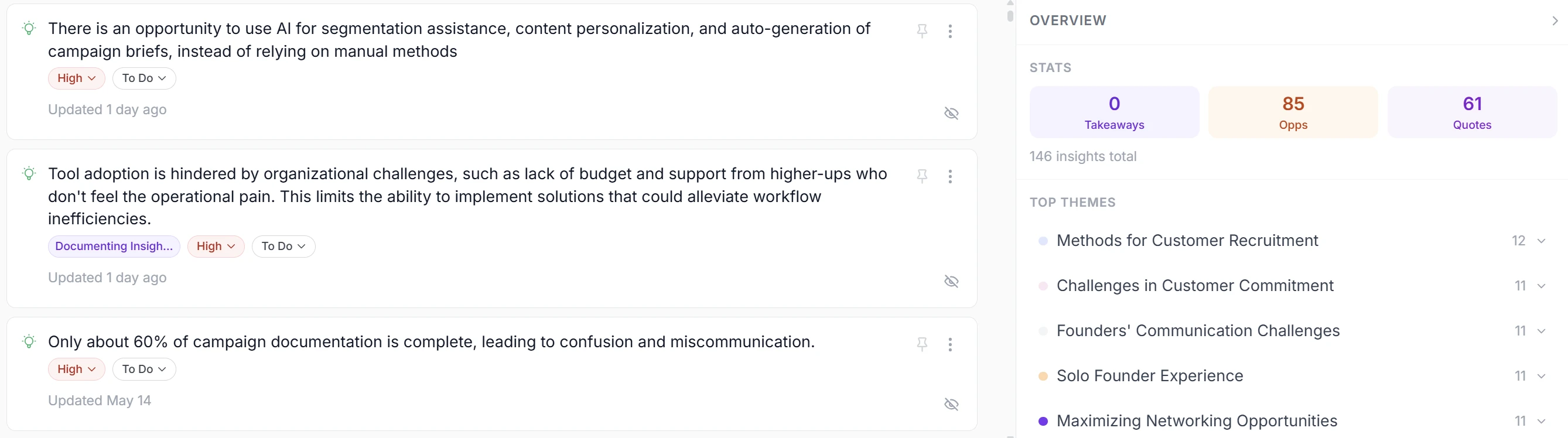
Feedback tools drive growth by helping you understand customer sentiment and act on it quickly. They streamline collection from many sources, make analysis timely, and turn raw input into decisions.
The payoff:
- Better, evidence-based product development
- Stronger customer relationships
- A real competitive edge from moving faster than teams that guess
Key Features to Look For
When evaluating customer feedback management software, prioritize:
- AI synthesis — auto-theming, sentiment, and trend detection across unstructured feedback. In 2026 this is table stakes.
- Multi-channel collection — surveys, in-app, support, interviews, reviews.
- Integrations — clean connections to your CRM, support desk, and roadmap tools.
- Prioritization and roadmap — a path from insight to what you'll build next.
- Traceability — every theme linked back to the source quote, so conclusions stay defensible.
- Security & compliance — your customer data protected and policy-compliant.
The Top Product Feedback Tools for 2026
Research → roadmap
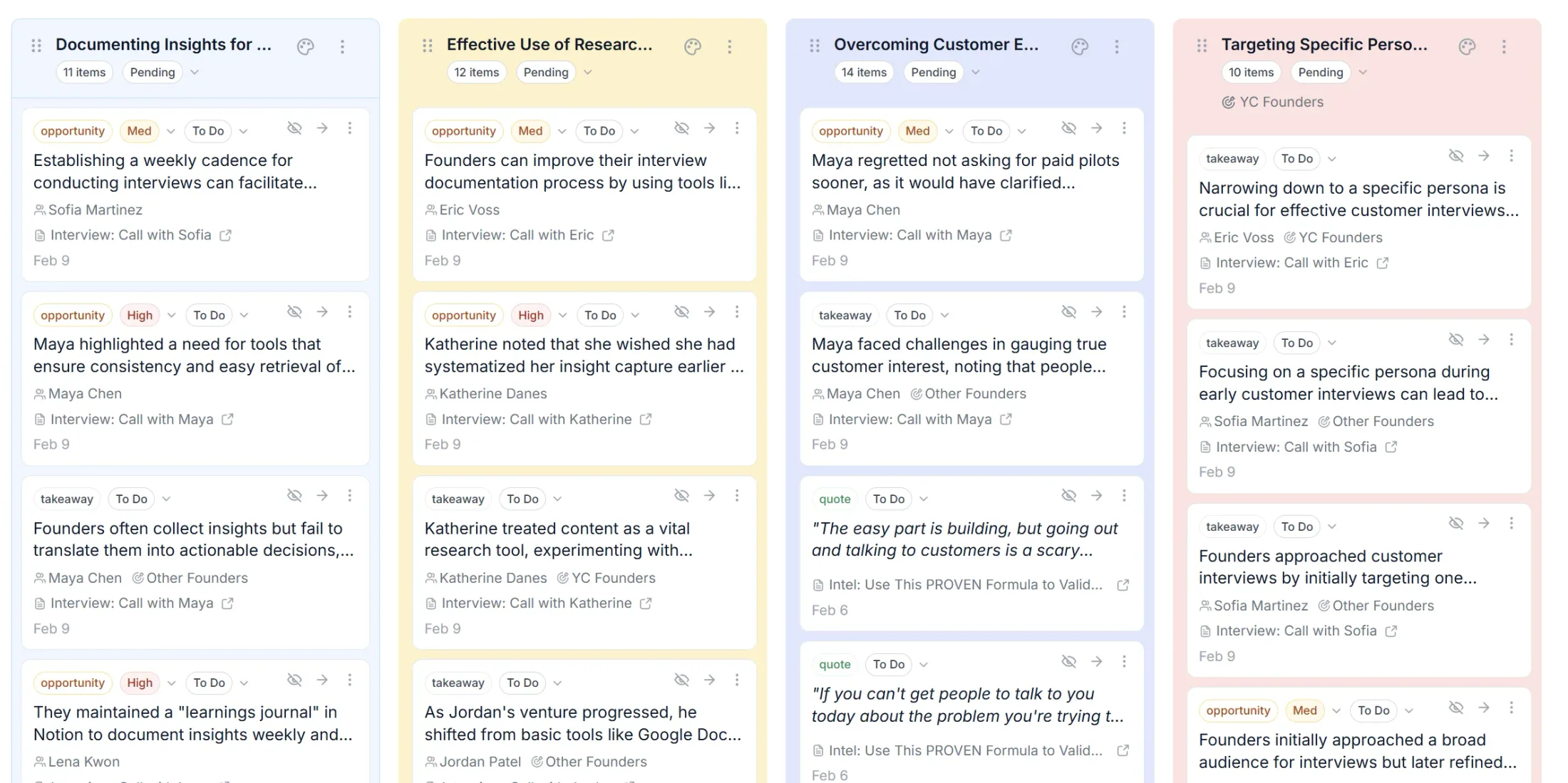
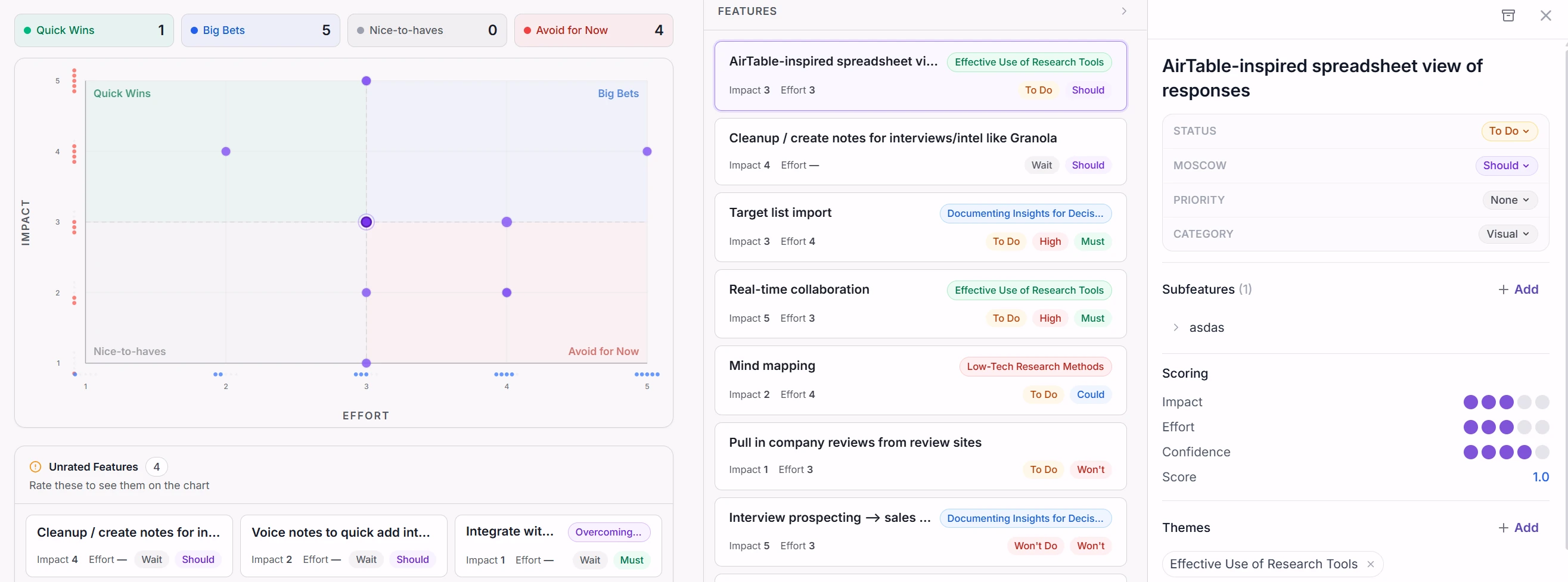
Intervool. Intervool is a customer research workspace that carries qualitative feedback all the way through: capture interviews (video, audio, transcript), synthesize evidence-linked themes, build dynamic personas and segments, and turn it all into a prioritized product roadmap — each decision one click from the customer quote behind it. Where most tools stop at collecting or storing feedback, Intervool is built for the messy middle between hearing something in an interview and deciding what to build.
- Interview capture with full transcripts
- AI synthesis into evidence-linked themes
- Personas, segments, and impact-vs-effort prioritization
- A roadmap you can defend, with an optional sales tie-in
Best for founders and product teams who run customer interviews and want them to actually shape the roadmap. See how Intervool works or how it compares.
Feature requests & public roadmaps
Canny. A clean, popular way to collect feature requests, let users vote, and communicate what's in progress. Strong fit for closing the loop with customers on a public roadmap.
Featurebase. A lightweight, affordable feedback-board-plus-roadmap-and-changelog tool that's become a go-to Canny alternative for teams that want simplicity and fast setup.
UserVoice. A long-standing feature-feedback platform with branded forums and prioritization, geared toward user-centric product development at scale.
Productboard. Roadmap and prioritization heavyweight that centralizes inputs and maps them to a plan. Powerful, with a steeper learning curve — better at roadmapping than raw collection.
In-app & behavioral feedback
Pendo. Combines in-app feedback with product analytics, so you can see what users do and ask why — popular for driving adoption.
Hotjar. Heatmaps, session recordings, and surveys that reveal how people actually use your site, great for UX and conversion work.
Sprig. In-app surveys and replays with AI-driven insights, designed to capture targeted signal at the moment of an experience.
Userback. Visual feedback with screenshot annotation and bug capture — handy for designers and developers tightening feedback loops.
Surveys
Typeform. Interactive, well-designed surveys that lift response rates, with broad integrations for distributing and collecting across channels.
Survicate. Targeted surveys across website, in-product, email, and shareable links, with a large template library and integrations that route responses into your stack — handy for collecting customer feedback at specific touchpoints in the journey.
AI feedback analytics (the new wave)
A cluster of newer startups focuses purely on making sense of feedback at scale with AI:
Unwrap.ai. AI-powered customer intelligence that automatically surfaces trends and issues across support tickets, calls, reviews, and surveys. Founded in 2021, it raised a Series A in early 2025.
Syncly. AI-driven feedback analysis that categorizes incoming feedback and flags negative trends early, aimed at support and CX teams drowning in tickets.
Enterpret. Unifies feedback from many sources into an adaptive taxonomy for analysis, oriented toward larger teams that want one quantified view of everything customers are saying.
Worth noting as a signal of where the category is heading: in mid-2025 Amplitude acquired Kraftful, an AI voice-of-customer startup, and folded it in. Expect more consolidation as analytics and feedback platforms absorb AI synthesis.
How to Choose the Right Feedback Management System
Start from your team's objectives and the kind of insight you need, then weigh functionality, ease of use, and integrations against your workflow.
- What's your primary input? Mostly interviews and qualitative research → a research-to-roadmap workspace. Mostly tickets and reviews at volume → an AI feedback-analytics tool. Mostly feature requests → a voting/roadmap board.
- Scalability and customization for where you're headed, not just today.
- Integrations with your existing stack.
- Security and compliance that meet your standards.
The cleanest setups avoid stitching five tools together — one workspace that takes you from raw feedback to a decision beats a pile of disconnected point tools.
Best Practices for Using Feedback Platforms
- Encourage open-ended responses; the richest insight is qualitative.
- Mix methods — surveys, interviews, in-app, support — for a complete picture.
- Analyze promptly with thematic synthesis so patterns surface while they're still actionable.
- Close the loop — act on insights and tell customers what changed.
Trends Shaping Feedback Tools in 2026
- AI synthesis as default. Auto-tagging, sentiment, and trend detection are now expected, not premium.
- Qualitative meets quantitative. Teams increasingly want the "why" (interviews, open text) connected to the "what" (analytics) in one place.
- Consolidation. Analytics suites are absorbing AI feedback startups (e.g., Amplitude + Kraftful), so standalone tools are differentiating on depth and workflow.
- From repository to roadmap. The advantage is shifting from simply storing feedback to turning it into prioritized, defensible decisions.
Conclusion: Turn Feedback Into Decisions
The right product feedback tool does more than collect input — it helps you act on it. Whichever category fits your team, aim for a system that connects what customers say to what you build, and keeps improving as you learn.
If most of your signal comes from customer conversations, that's exactly what Intervool is built for. Start a free trial — 30 days, no credit card — or see how Intervool works.