You've done the hard part — you actually talked to customers. Now you have fifteen recordings, a folder of notes, and a planning meeting on Thursday. This is where most teams fumble: the interviews were rich, but what reaches the roadmap is whatever fragments people happen to remember. Here's a pipeline that gets you from raw conversations to a prioritized roadmap without losing the evidence along the way.
Step 1: Extract structured insights from every interview
Don't work from memory or skim notes. For each interview, pull out discrete insights — pain points, feature requests, workarounds, goals — each linked to who said it and where in the conversation. The unit matters: "onboarding is confusing" is too vague; "spent two days on the CSV import and nearly gave up before inviting the team" is an insight you can act on.
Doing this by hand across a batch of interviews takes days, which is why it usually doesn't happen. AI-assisted tools handle the extraction pass in minutes — how to analyze customer interviews covers the approaches.
Step 2: Cluster what repeats into themes
Lay the insights out and group the ones describing the same underlying problem. Eight insights about import friction from six different companies is a theme; a single request for a Salesforce integration is, so far, an anecdote. Synthesizing conversations into themes walks through this in depth.
Two rules keep clustering honest:
- Cluster problems, not solutions. "Needs bulk edit" and "needs CSV re-import" might be the same underlying problem (fixing data at scale) wearing two suggested solutions.
- Keep the receipts attached. Every theme should retain its source insights and quotes. You'll need them at scoring time — and in the planning meeting.
Step 3: Weigh themes by frequency and segment
Not all themes are equal. For each one, ask:
- How often? A theme appearing in 8 of 12 interviews outranks one appearing twice.
- From whom? A theme concentrated in your target segment beats a broader but off-ICP one. This is where segments earn their keep — the same pain can matter completely differently depending on who has it.
- How severe? Listen for workarounds, budget spent, or emotion. A problem customers have duct-taped a spreadsheet over is real; a "that would be nice" is not.
This weighting step is what protects you from the classic failure mode: building for the loudest customer instead of the most common problem.
Step 4: Turn top themes into feature bets and score them
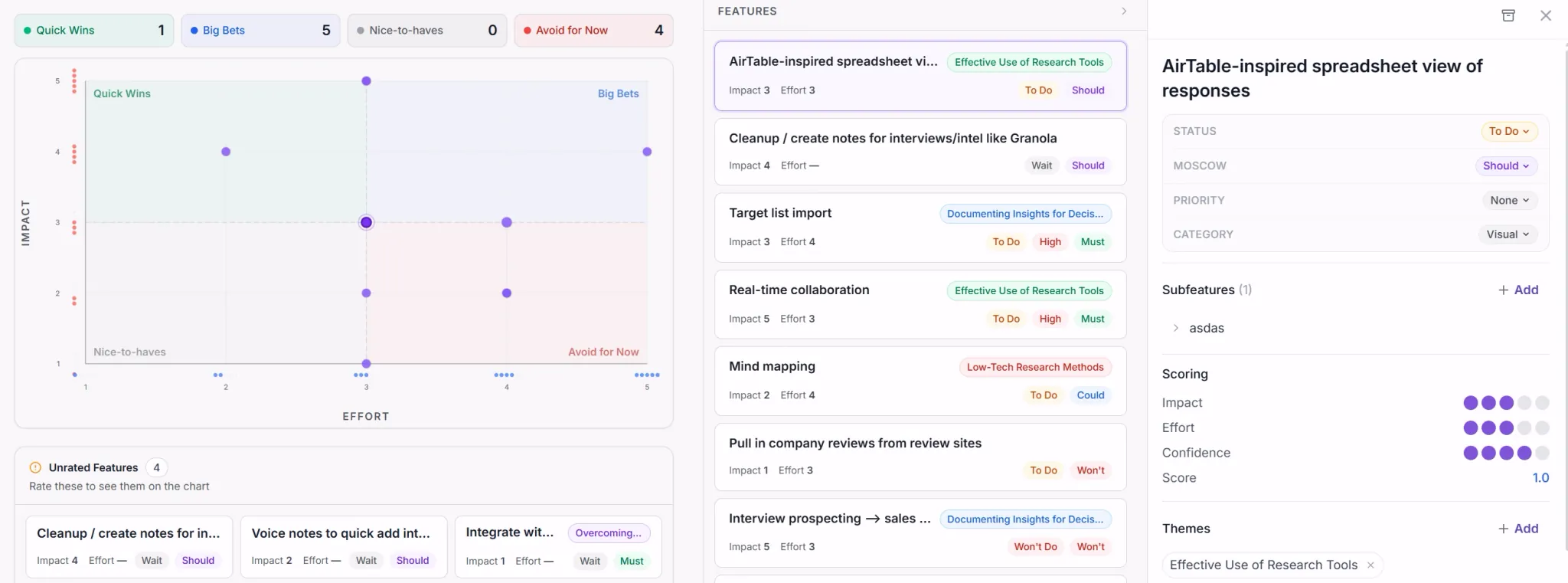
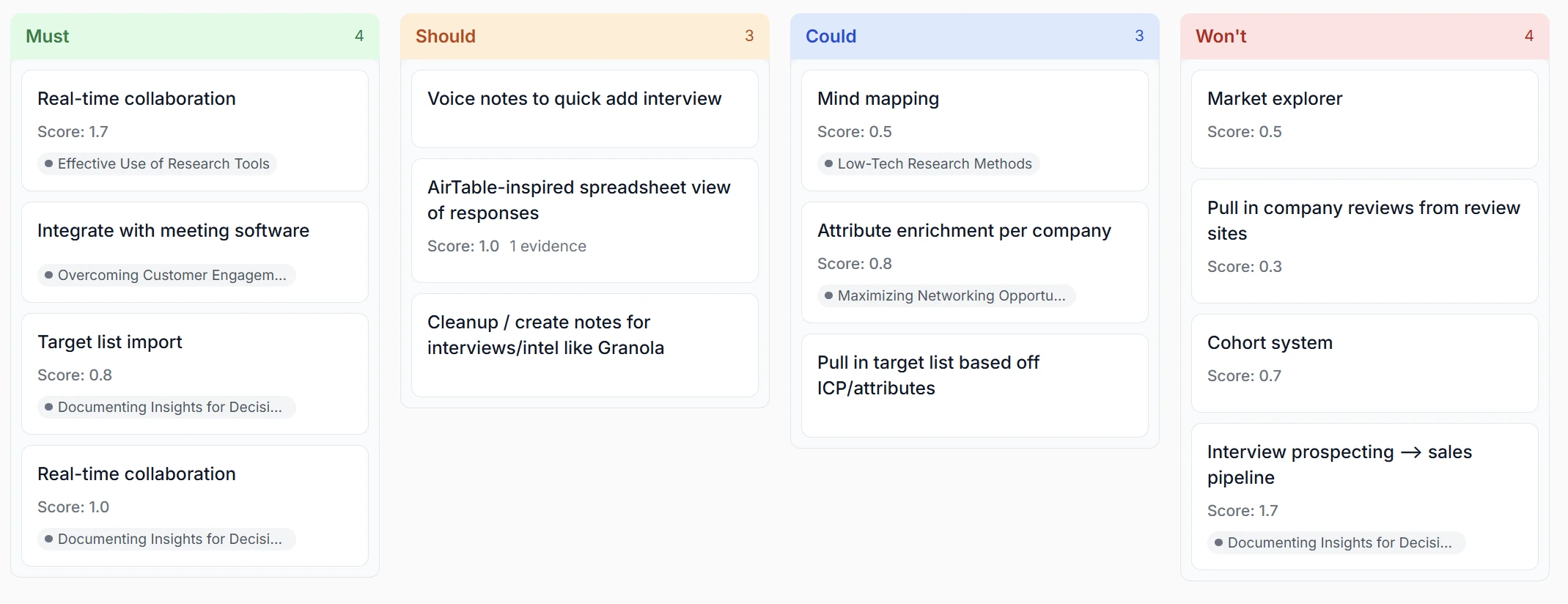
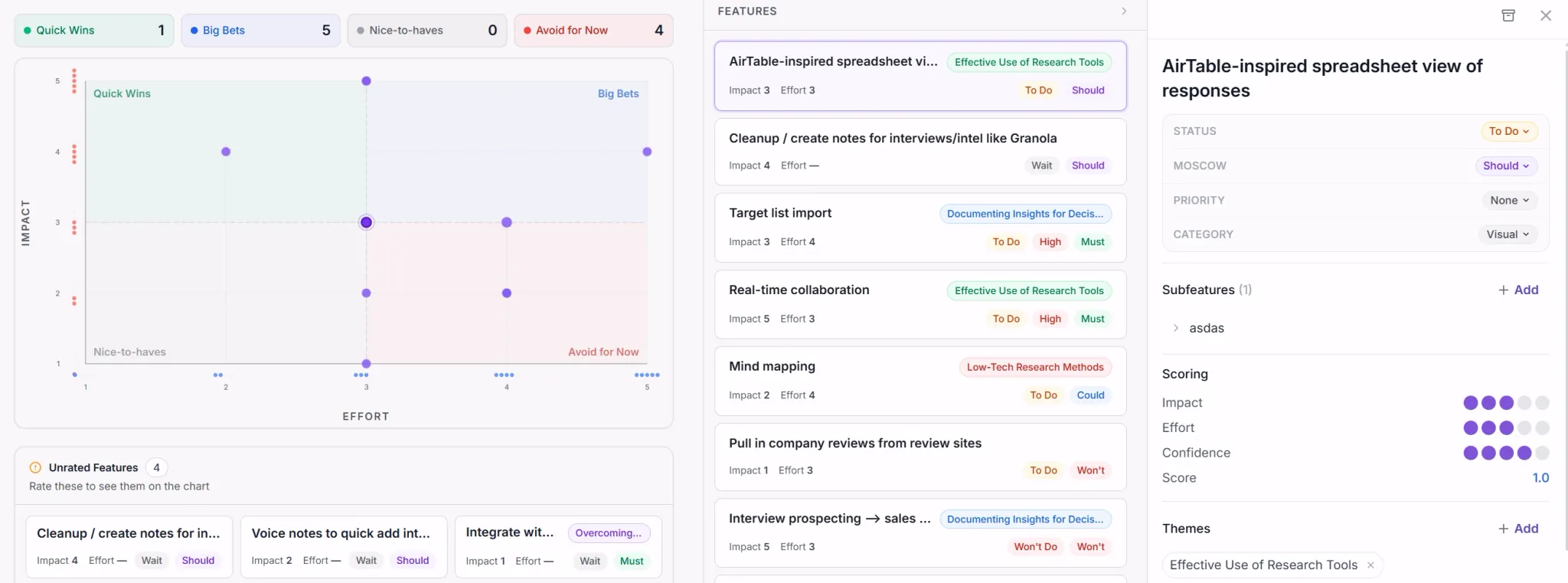
Convert your weightiest themes into candidate features, and score them on an explicit framework — impact vs effort is the fastest to run: impact informed by theme frequency, segment fit, and severity; effort from a quick engineering gut-check. Plot the 2×2 and the roadmap conversation gets much shorter: quick wins first, big bets scheduled deliberately, money pits declined with a reason you can show. (RICE and MoSCoW are alternatives — the framework matters less than using one consistently.)
The stakes of skipping the scoring step are measurable: Pendo found 80% of shipped features are rarely or never used. That's what a roadmap looks like when the pipeline from evidence to priority is broken.
Step 5: Keep every priority linked to its evidence
The final — and most often skipped — step: when a theme becomes a roadmap item, the link back to the interviews must survive. It's what lets you defend the priority to stakeholders, re-check the reasoning when circumstances change, and go back to the exact customers who described the problem when it ships.
This pipeline — extract, cluster, weigh, score, trace — is exactly what Intervool automates: AI extracts insights from every interview linked to the transcript moment, clusters them into themes, shows frequency and segment breakdowns, and carries the winners into an impact-vs-effort roadmap where every bet is one click from the quote behind it. Start a free trial and run your next planning cycle on evidence.