Ask a product team why an item is on their roadmap and you'll usually hear some version of "leadership wants it," "a big customer asked," or "we've been meaning to do it for a while." None of those are evidence. An evidence-based product roadmap is one where every item can be traced to customer research — who has the problem, how many, how badly, and what they actually said.
The cost of skipping this is well documented. Pendo's analysis found 80% of product features are rarely or never used, and CB Insights' post-mortem of failed startups found 43% cited poor product-market fit — building things nobody needed. Both are the same failure at different scales: a roadmap disconnected from evidence.
What counts as evidence (and what doesn't)
Not all input is evidence. A rough hierarchy:
- Strong: patterns that repeat across customer interviews — the same pain point surfacing in eight different conversations, across more than one segment, unprompted.
- Useful: usage data showing where customers struggle or drop off; support themes; churned-customer interviews.
- Weak: a single passionate request, a competitor shipping something, a stakeholder's conviction, vote counts on a feedback board. These are prompts to investigate, not reasons to build.
The dividing line is repetition and independence. One customer describing a problem is an anecdote. Ten customers describing it independently, in their own words, is evidence. (This is also why building for the loudest customer fails — volume from one account isn't repetition across many.)
The practice, step by step
1. Interview continuously, not in bursts. Evidence goes stale. A discovery push six months ago tells you what was true six months ago. Teams with evidence-based roadmaps treat interviewing as an always-on habit — a few conversations a week — so the evidence base is current when planning happens. How to conduct customer interviews covers the mechanics.
2. Synthesize into themes before planning. Raw interviews aren't usable at roadmap altitude. Extract the insights from each conversation — pain points, opportunities, quotes — and cluster what repeats into themes. Each theme should carry its receipts: how many interviews it appeared in, which segments, and the strongest quotes.
3. Require a citation for every roadmap item. This is the structural move that changes behavior. An item doesn't get a slot unless it links to the theme — and through it, the interviews — that justify it. "No evidence, no slot" sounds harsh; in practice it just redirects energy from lobbying to research.
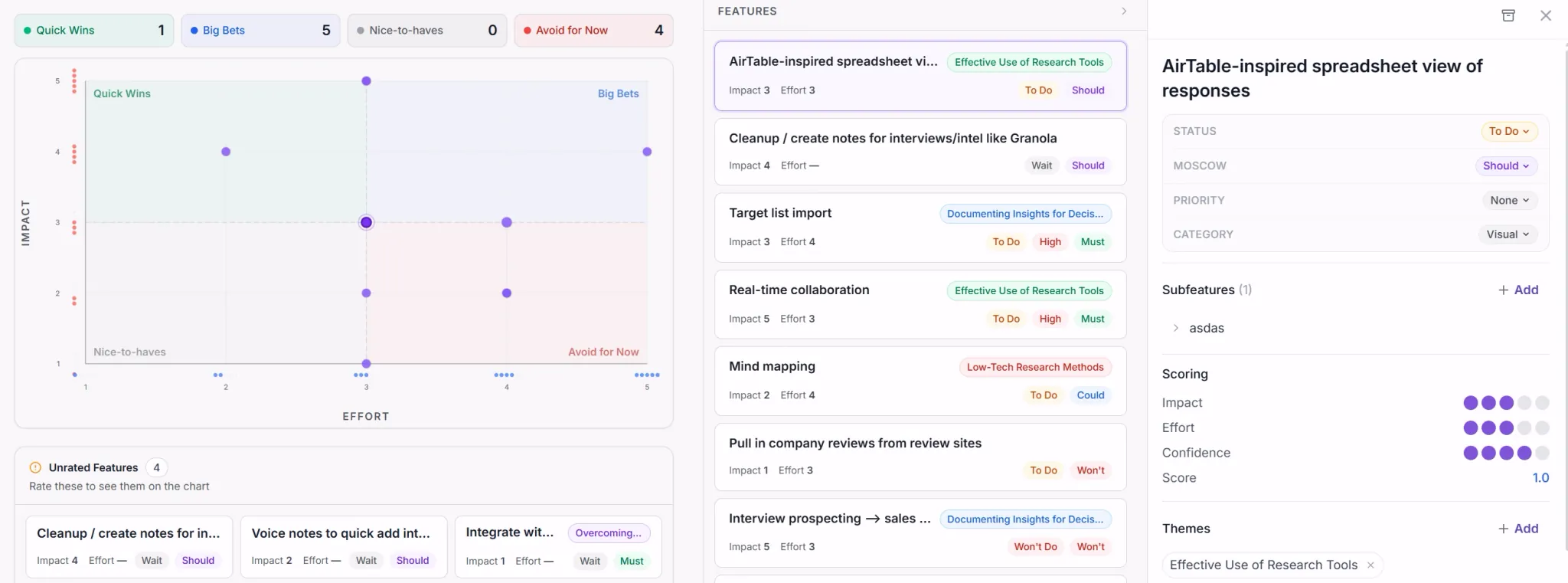
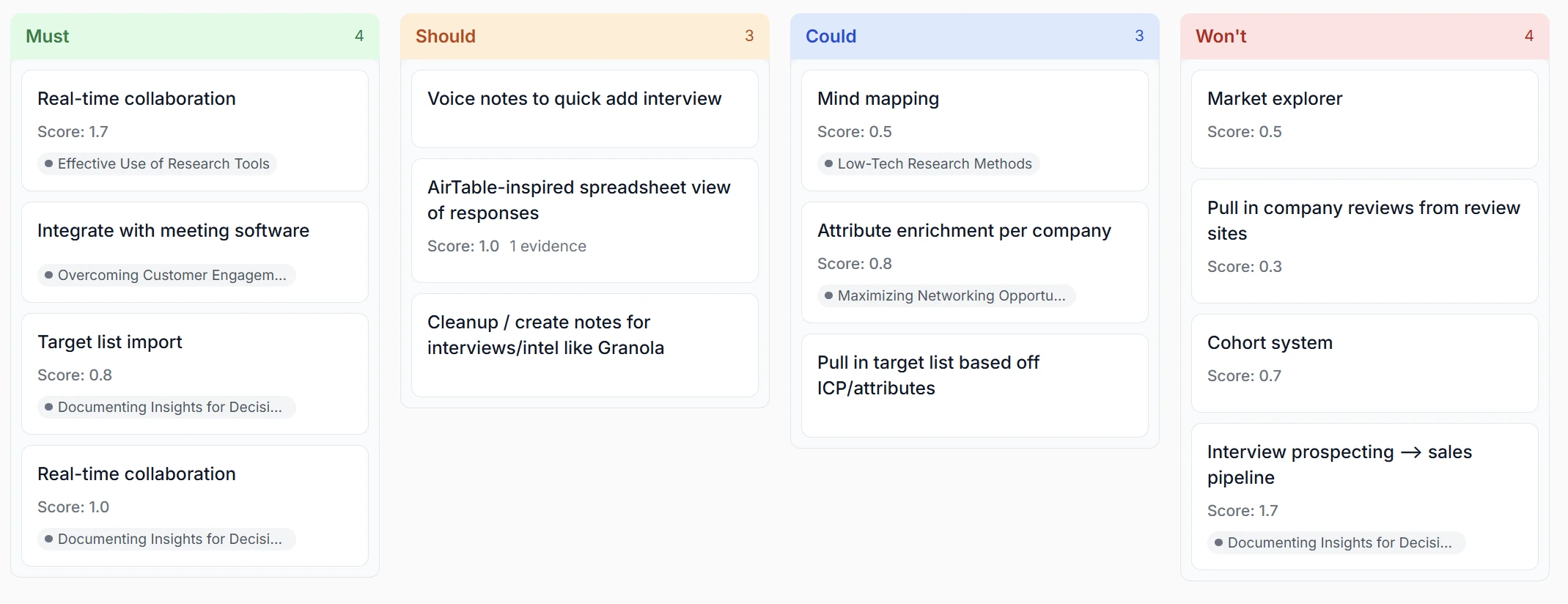
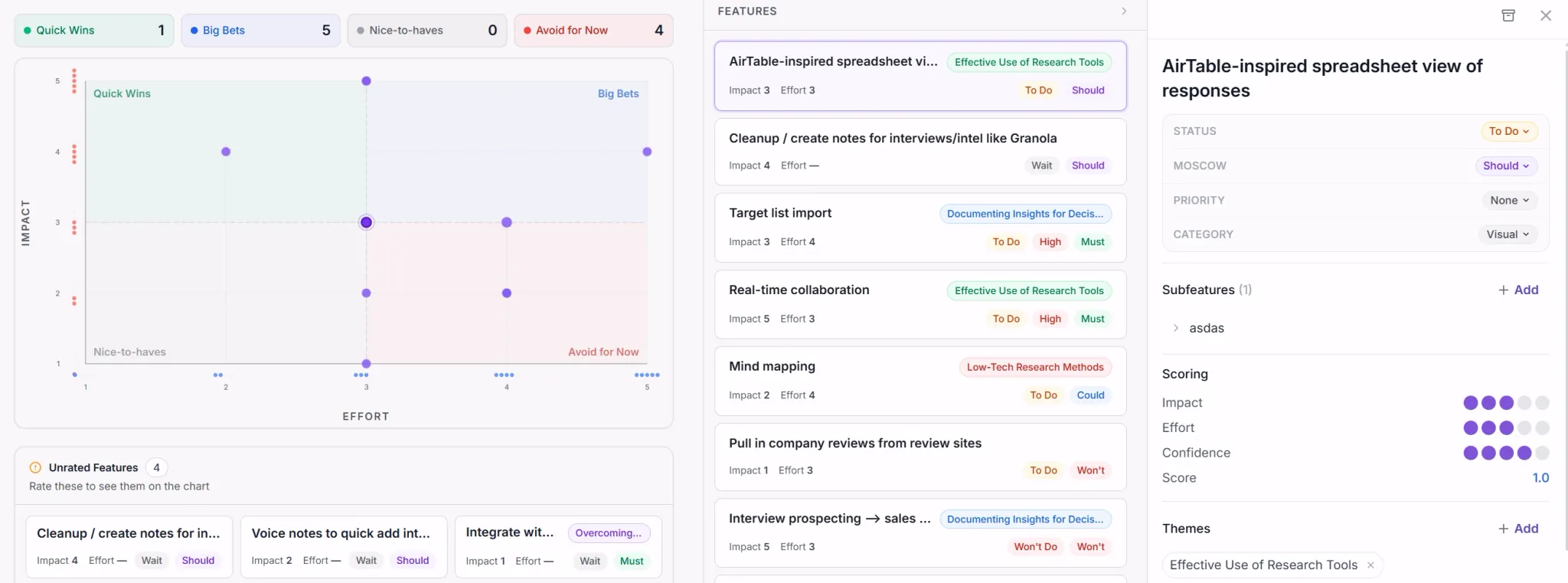
4. Score in the open. Use an explicit framework — impact vs effort, RICE, or MoSCoW — and let the evidence inform the scores. Reach stops being a guess when you know how many interviews surfaced the problem; impact stops being vibes when you've heard customers describe the workaround they're suffering through.
5. Let new evidence move items. An evidence-based roadmap is falsifiable — that's the point. When new interviews contradict a priority, the priority moves. If nothing has moved in two quarters, the team has stopped learning, not finished learning.
Defending the roadmap (the payoff)
The biggest practical benefit isn't better decisions — though you get those — it's shorter arguments. When a stakeholder challenges a priority, you don't debate opinions; you walk them from the roadmap item to the theme to the actual customer quotes in about thirty seconds. When they ask why their pet feature isn't on it, you show what the evidence supports instead. The conversation becomes "here's what we know" rather than "here's what I think."
That traceability is exactly what Intervool is built for: it captures and transcribes interviews, extracts insights linked to the exact transcript moment, clusters them into themes, and scores feature bets on impact vs effort — so every roadmap item stays one click from the customer evidence behind it. See how it works or start a free trial.