For most of product management's history, synthesizing customer research was a manual slog: re-listen to calls, transcribe by hand, mind-map sticky notes, hope you remembered the important parts. The product leaders we talked to are clear that this is the part AI changes most — and also the part where it's easiest to overreach. It's a real shift: in a blinded, peer-reviewed comparison, large language models matched expert analysts at thematic analysis of interview transcripts — 93.5% agreement with an expert panel versus 92.7% for humans — though the researchers frame AI as an adjunct to human judgment, not a replacement.
What AI is genuinely good at here
Used well, AI compresses days of synthesis into minutes:
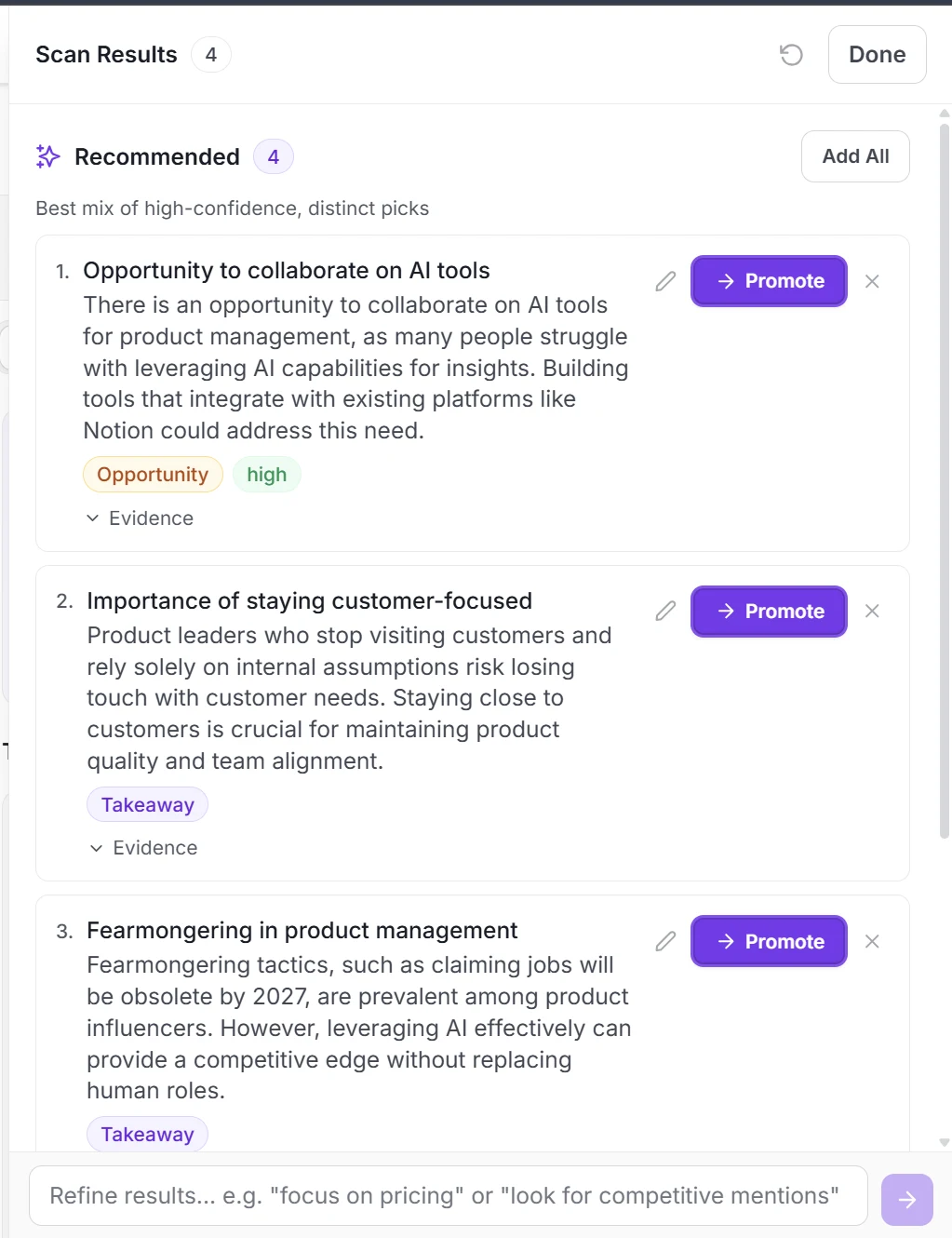
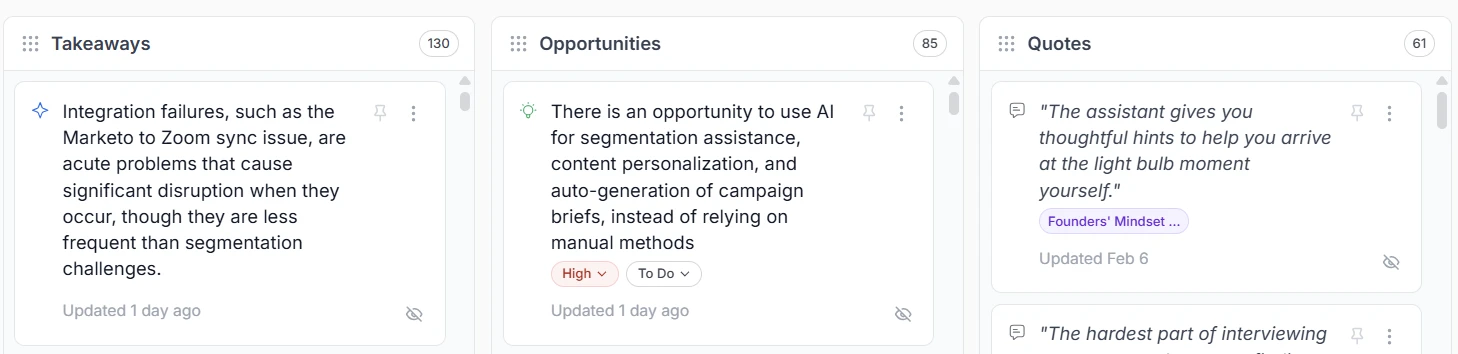
- Transcription and extraction. Modern tools ingest video and transcripts from calls and automatically pull structured outputs — pain points, opportunities, quotes, feature requests — instead of you scrubbing recordings.
- Pattern recognition at scale. This is the unlock. Aggregating many transcripts (one leader pointed to 50+) lets you see themes no single interview reveals — and surfaces the questions you haven't asked yet.
- Clustering and affinity mapping. AI can group related observations so you can visualize and prioritize what matters, rather than starting from a blank wall of notes.
- Fast iteration. For drafting reports, positioning, and first passes, AI is a force multiplier — one leader uses it constantly to iterate and refine.
The throughline: AI is best at the volume work — reading everything, tagging it, and surfacing what repeats — which is precisely where human synthesis breaks down.
Where judgment still has to be human
Every leader we spoke with drew the same line. AI accelerates the process; it doesn't own the decision.
- "AI product manager" isn't a skill. As one put it, calling yourself an AI PM doesn't mean you know how to use AI to do the actual job. The foundation of product management is still creating an experience that makes someone's life better — AI might help, or might not.
- Don't let it think for you. Spend too long letting a model refine a recommendation and you can talk yourself into something that doesn't hold up. Use it to stress-test, not to conclude.
- Avoid the echo chamber. AI tends to validate your framing. Pair it with diverse human perspectives and real customer evidence so synthesis doesn't become sophisticated confirmation bias.
- Keep critical thinking in the loop. The goal isn't to automate insight — it's to spend less time gathering and more time deciding what the insight means.
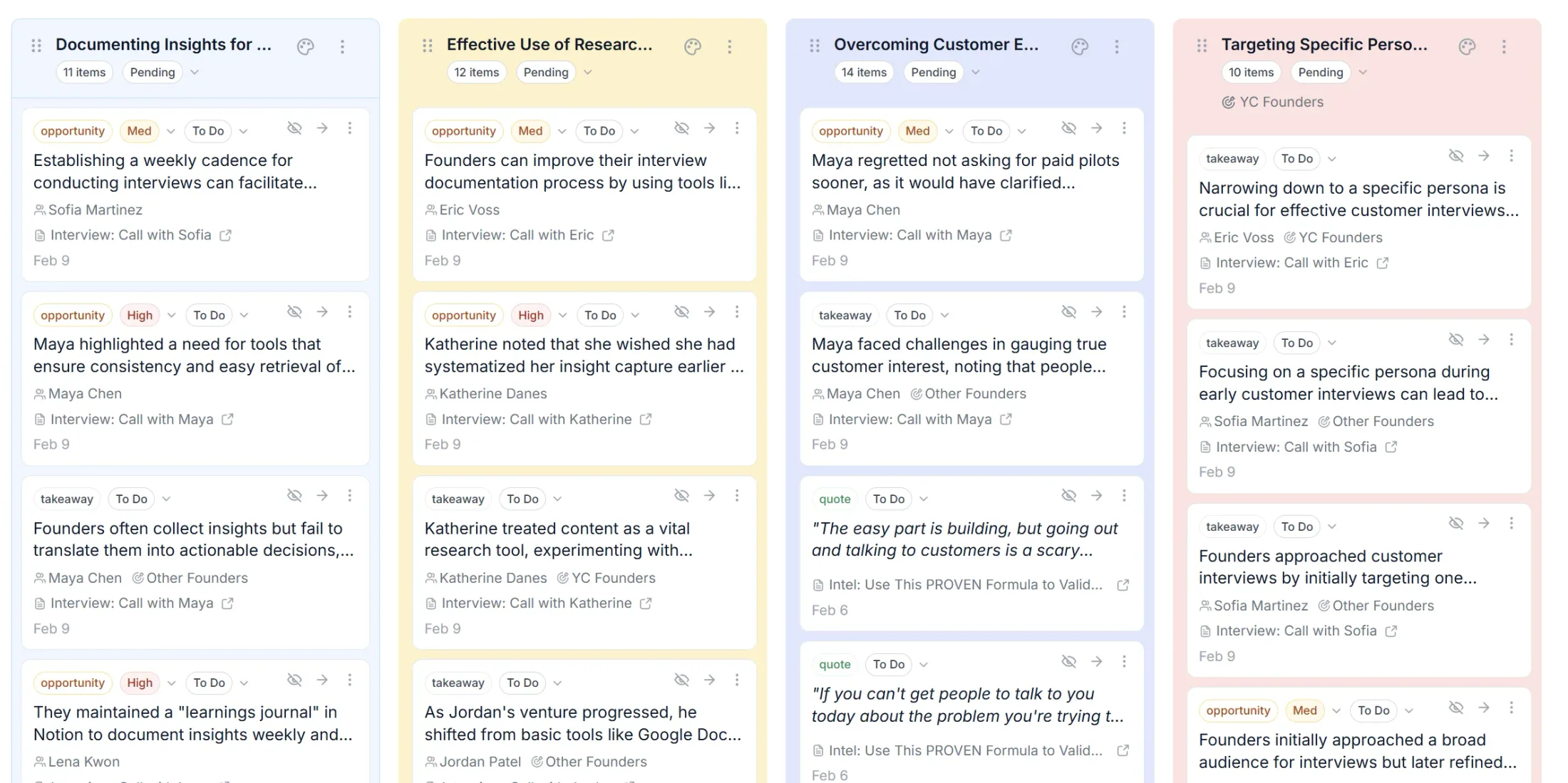
A practical workflow
- Capture everything. Record and transcribe each interview so nothing is lost.
- Auto-extract. Let AI pull pain points, opportunities, and quotes, each linked back to the moment it came from.
- Cluster into themes. Use affinity mapping to group recurring signals across calls, personas, and segments.
- Compare and challenge. Triangulate against market and competitor analysis; ask the model for the counter-case.
- Decide like a human. Prioritize with judgment, then trace each decision back to the evidence.
How Intervool fits
This workflow is exactly what Intervool is built for: capture interviews, auto-synthesize evidence-linked themes, cluster them, and carry the result into a prioritized product roadmap — every decision one click from the customer quote behind it. AI does the reading and the grouping; you keep the judgment.
Spend less time gathering and more time deciding. See how Intervool works or start a free trial.