You ran the interviews. Now comes the part that actually creates value — and where most teams stall: the analysis. Customer interview analysis is how a stack of recordings becomes a clear picture of what customers need and what to build. This is a step-by-step guide to doing it well, whether by hand or with AI. It's worth doing fast, too: McKinsey finds fast decision-makers are 2× as likely to also make high-quality decisions, so the sooner analysis turns a stack of calls into a clear picture, the better.
What is customer interview analysis?
Customer interview analysis (also called user interview analysis) is the process of reviewing your interviews to extract the insights that matter — pain points, needs, requests, and the themes that repeat across conversations — and turning them into decisions. The goal isn't a summary of each call; it's a synthesized understanding across calls that you can act on. (See customer interview analysis software for how Intervool automates it.)
Step 1: Transcribe and prepare
You can't analyze what you can't read. Transcribe every interview so quotes are searchable, and gather them in one place — see how to transcribe an interview if you're weighing doing it by hand against software. Clean transcripts also let you spot nuance — hesitation, emphasis, exact wording — that memory loses.
Step 2: Code (tag) the transcripts
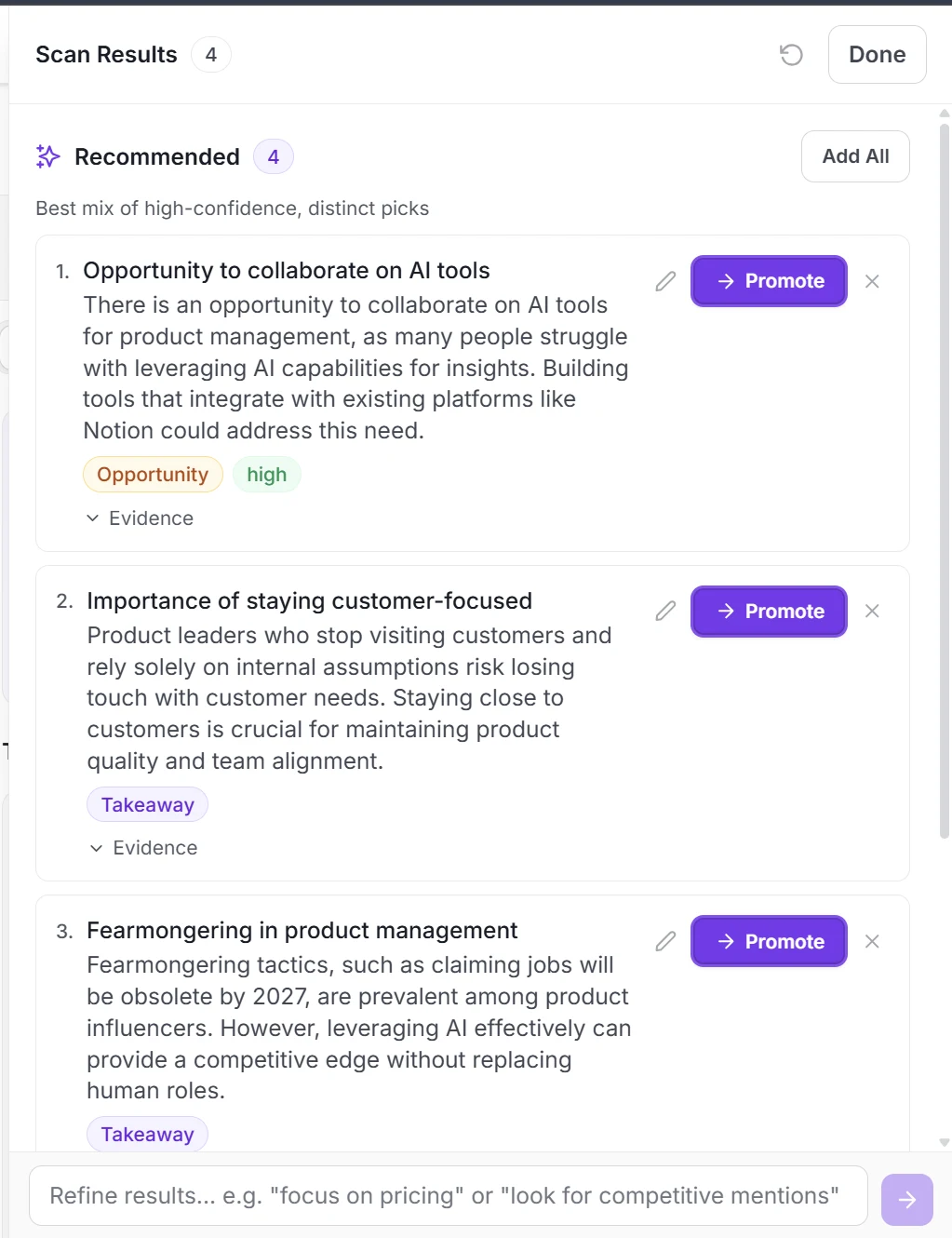
Go through each transcript and tag meaningful moments — pain points, opportunities, feature requests, quotes, and surprises. Keep tags linked to the exact spot they came from so every later claim is verifiable. Use a consistent, evolving tag set so tags mean the same thing across interviews.
Step 3: Cluster tags into themes
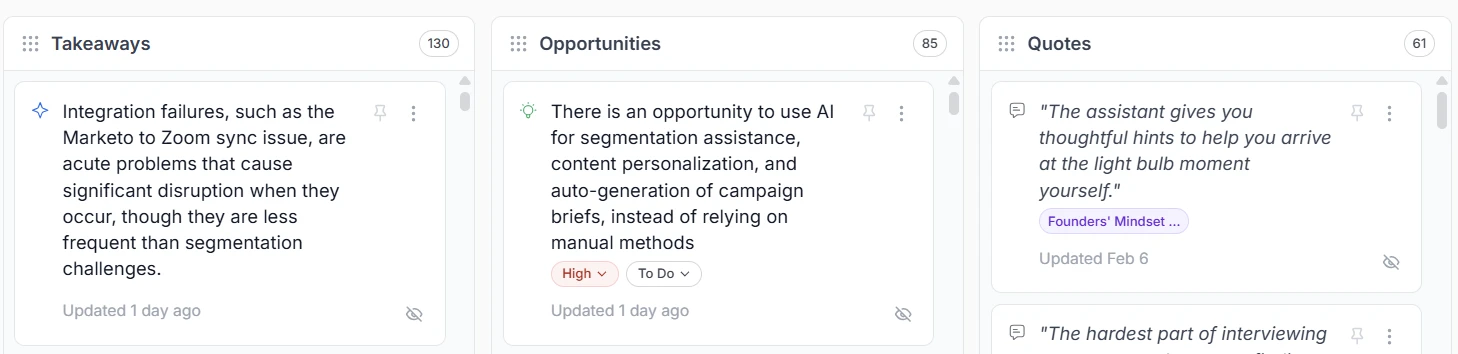
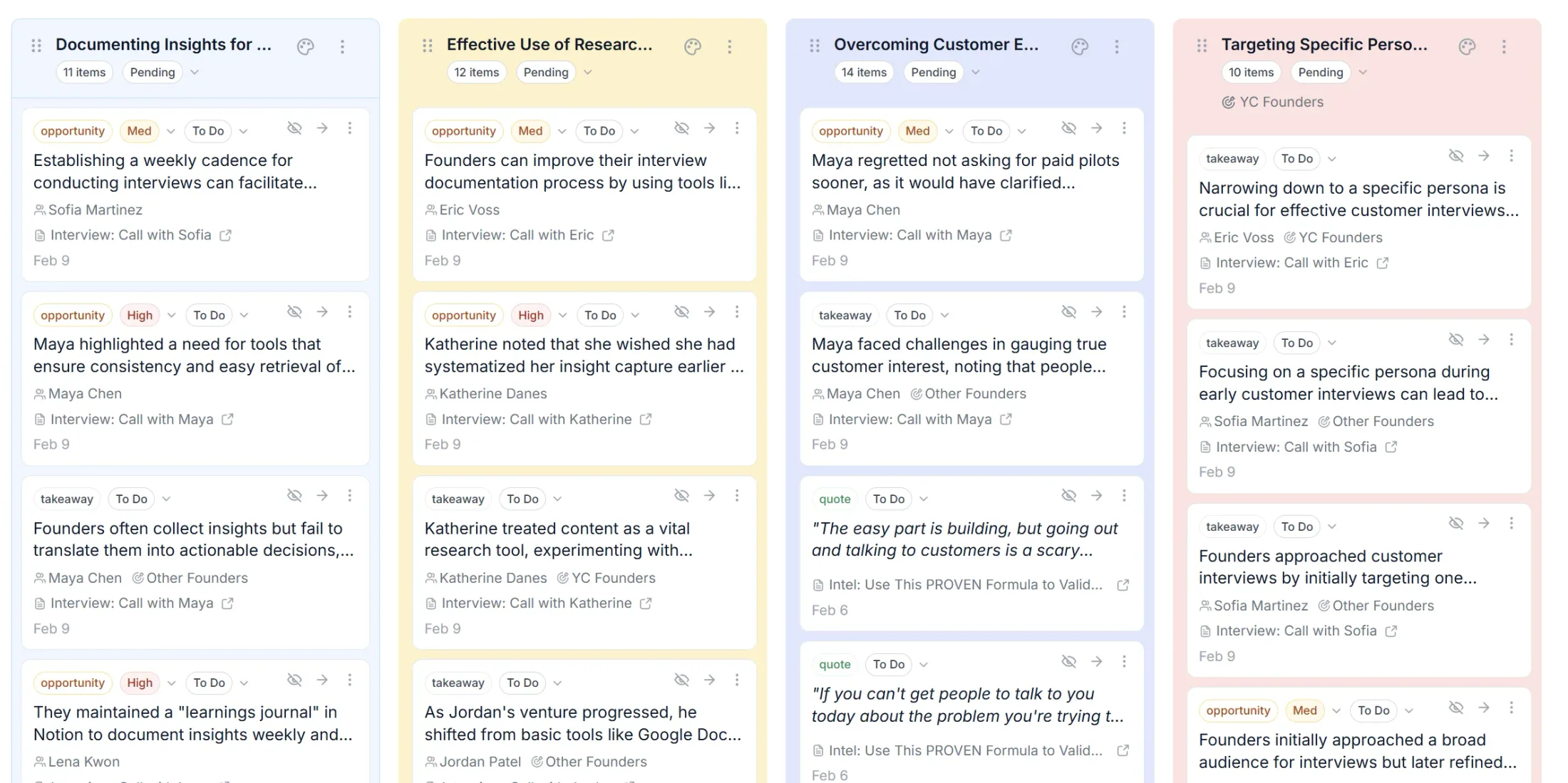
Group related tags into themes — this is thematic synthesis (often via affinity mapping). A theme is a pattern that shows up across multiple people, not a one-off comment. This is the step that turns scattered tags into signal. For the full method, see thematic analysis of customer interviews; for the hands-on clustering session, affinity mapping in UX research.
Step 4: Find the patterns that matter
Look across themes for what's frequent, intense, and shared across segments — and mute the outliers. Weighting by prevalence (and, in B2B, by revenue at risk) keeps you from over-indexing on the loudest customer. Watch your own confirmation bias here.
Step 5: Put it in context
Filter findings through the questions that matter: Who said this — and for which segment? Does it match or contradict other evidence? Is it a need or a solution in disguise? Context turns a quote into an insight.
Step 6: Distill into decisions
Translate themes into clear, actionable insights and prioritize them — typically on impact vs. effort. Tie each priority back to the quotes behind it so you can defend the roadmap with evidence, then share it and act.
How to analyze customer interview transcripts: a worked example
The six steps above are the method; here is what it looks like on one real transcript, so you can see the shape of the work before you scale it.
Say you ran a 40-minute discovery call using the free customer interview template. The transcript is about 6,000 words. Analyzing it looks like this:
- Read it once without tagging. Ten minutes. You are looking for the moments where the person's tone changed — frustration, a laugh, a pause before answering. Mark those lines. In this call there are four: a complaint about re-exporting a report every Monday, a workaround involving two spreadsheets, an offhand "we tried a tool for this and gave up", and a wish for "something that just tells me what changed".
- Tag the moments, not the paragraphs. Each mark becomes a tagged insight with the exact quote attached: pain: weekly re-export, workaround: dual spreadsheets, churn signal: abandoned tool, request: change summary. Four tags from one call is normal — a transcript is not a list of insights, it is a story with a few insights in it.
- Add the context. Who is this — role, company size, segment — and how strongly did they feel it? The re-export complaint came with a sigh and a specific time cost ("an hour every Monday"); the change-summary wish was a shrug. Weight them accordingly.
- Put it next to the other transcripts. Alone, four tags are anecdotes. Across eight calls, weekly re-export shows up five times from the same segment and change summary once — now you have a theme with five pieces of evidence and a stray request you can park.
- Write the theme as a decision, not a summary. Not "users find reporting tedious" but "ops leads at 50–200-person companies spend ~1 hr/week rebuilding a report we could generate — 5 of 8 interviews". That sentence is the thing that survives into the roadmap, and every number in it links back to a transcript line.
Done by hand, a transcript this size takes 45–60 minutes to analyze well. Done with AI extraction in a tool like Intervool, steps 1–3 take a couple of minutes to review rather than an hour to produce, and step 4 happens automatically as the eighth transcript lands — which is the difference between analyzing every interview and analyzing the ones you had time for.
Manual vs. AI-assisted analysis
Doing all of this by hand — re-watching calls, tagging line by line, mind-mapping sticky notes — can take days per round, which is exactly why analysis so often gets skipped. AI-assisted analysis compresses it: transcription, extraction of tagged insights, and theme clustering happen automatically, so you spend your time on interpretation and decisions. The key is keeping every AI-surfaced insight linked to its source so you can verify it. (More on synthesizing research with AI without the echo chamber.) If the work needs a defensible audit trail — codebooks, memos, queries — compare the qualitative data analysis software built for that.
Common mistakes to avoid
- Summarizing instead of synthesizing — per-call summaries aren't analysis; the value is the pattern across calls.
- Cherry-picking the quote that fits your plan.
- Losing the source — untraceable claims can't be trusted or defended.
- Stopping at insight — analysis that never reaches the roadmap is wasted.
Analyze interviews with Intervool
Intervool does the heavy lifting of customer interview analysis: it transcribes each call, extracts pain points, opportunities, and quotes linked to the moment they were said, clusters what repeats across conversations, and carries the themes into a prioritized roadmap. Analysis in minutes, not days — and every insight one click from the source. See how it works or start a free trial.