Customer interviews are the fastest way to understand what your customers actually need — not what you assume they need. Done well, 10–15 conversations can reshape your product direction. Done poorly, they confirm whatever you already believed. The upside is worth it: CB Insights' analysis of failed startups found 43% cited poor product-market fit — building something customers didn't need — the exact failure customer interviews exist to prevent.
This guide covers how to conduct customer interviews that actually generate insight: who to talk to, how to prepare, how to run the conversation, and how to turn what you hear into decisions.
Why customer interviews matter
Surveys tell you what people say they do. Analytics tell you what they actually do. Customer interviews tell you why — the context, the emotions, the workarounds, and the unmet needs that neither surveys nor analytics can capture.
The insight from interviews isn't just "nice to have." It's the difference between building features nobody uses and building something people genuinely need.
Step 1: Define your goal
Before you recruit anyone, answer: What decision will this research inform?
Bad goal: "Learn about our customers." Good goal: "Understand why mid-market companies churn in the first 60 days."
Your goal shapes everything — who you recruit, what you ask, and how you analyze the results. If you can't state the decision you're trying to make, you're not ready to do interviews.
Common interview goals
- Discovery: Understand how people handle a problem today, before you have a solution
- Validation: Test whether a specific idea or prototype resonates
- Usability: Check whether users can actually accomplish tasks in your product
- Churn: Understand why customers leave (or stay)
Pick one goal per round of interviews. Mixing goals muddies your questions and your analysis.
Step 2: Recruit the right participants
The most common mistake in customer research is talking to the wrong people. Five interviews with the right participants teach you more than fifty with the wrong ones.
Who to recruit
- Match your goal. If you're researching churn, talk to churned customers. If you're exploring a new segment, talk to people in that segment.
- Mix it up. Don't just talk to power users or fans. Include skeptics, churned customers, and people who considered you but chose a competitor.
- Be specific. "Small business owners" is too broad. "Founders of 5–20 person B2B SaaS companies who handle their own customer research" is better.
Where to find participants
- Your existing customers: Reach out directly via email. People are more willing to help than you think.
- Churned customers: Often the most valuable — they'll tell you what went wrong.
- Recruiting panels: Services like User Interviews or Respondent can find specific profiles.
- Communities: Slack groups, Reddit, LinkedIn — wherever your target audience hangs out.
How many interviews
For most questions, 8–12 interviews per segment is enough to see patterns. You'll know you've done enough when the same themes keep repeating.
Step 3: Prepare your questions
A good interview guide keeps you focused without making the conversation feel scripted.
Structure your guide
- Context questions (2–3 min): Understand who you're talking to — role, company, experience.
- Core questions (20–25 min): The meat of your interview, focused on your goal.
- Open closer (2–3 min): Give them space to share what you didn't think to ask.
Write better questions
Do:
- Ask open-ended questions: "Walk me through how you handle X today."
- Focus on past behavior: "Tell me about the last time you..."
- Follow up: "Why?" and "Tell me more about that."
Don't:
- Lead the witness: "Don't you think it would be better if...?"
- Ask hypotheticals: "Would you use a feature that...?" (People are bad at predicting their own behavior.)
- Ask yes/no questions: They kill the conversation.
See our Customer Interview Questions Template for 30+ questions organized by goal.
Step 4: Set up the call
The logistics matter more than you think.
Before the interview
- Send a calendar invite with a clear title and video link.
- Confirm the day before. A quick "Looking forward to our chat tomorrow" reduces no-shows.
- Test your setup. Make sure your camera, mic, and recording software work.
- Have your questions ready in a doc or your interview template.
Recording and note-taking
Record every interview. You can't take good notes and be fully present at the same time — and the exact words people use matter.
Options:
- Built-in recording: Zoom, Google Meet, and most video tools can record.
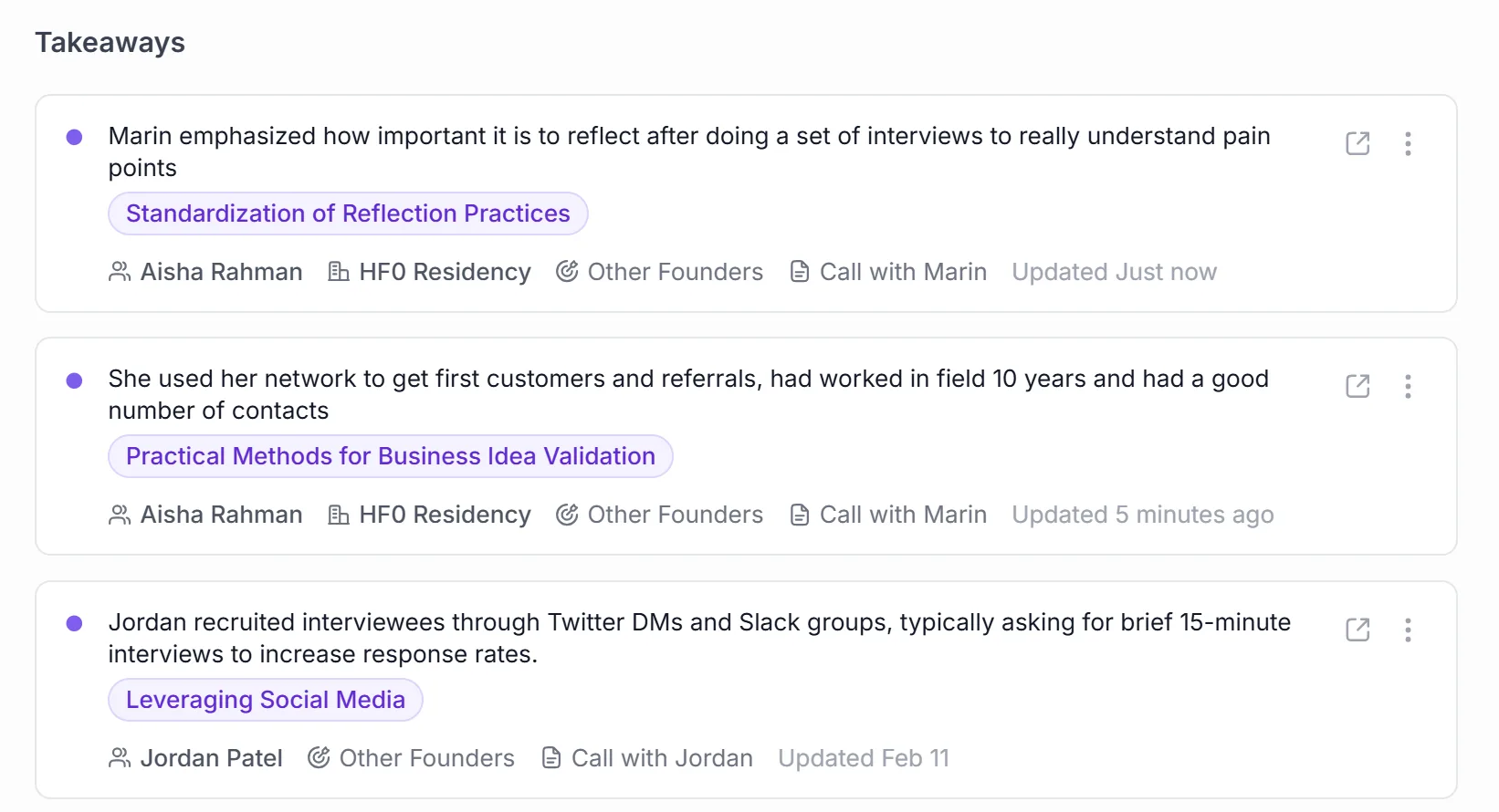
- Dedicated tools: Customer interview software like Intervool captures the recording, transcribes it, and extracts insights automatically.
Always ask permission to record. Most people say yes.
Step 5: Run the interview
The interview itself is a skill. Here's how to do it well.
Start warm
- Thank them for their time.
- Explain what you're trying to learn (briefly).
- Ask permission to record.
- Start with an easy context question to get them talking.
Listen more than you talk
The golden ratio is 80% them, 20% you. Your job is to understand, not to pitch or explain.
When they say something interesting, don't jump to the next question. Say:
- "Tell me more about that."
- "Why is that?"
- "Can you give me an example?"
These follow-ups are where the real insight lives.
Stay neutral
Don't react with "That's great!" or "That's a problem." Your reactions bias their answers. Nod, say "Interesting," and keep digging.
If they ask for your opinion, deflect: "I'm curious what you think first."
Take light notes
Jot down key phrases, surprising moments, and follow-up questions — but don't try to transcribe everything. That's what the recording is for.
Close well
- Ask: "Is there anything I should have asked that I didn't?"
- Thank them sincerely.
- If appropriate, mention what happens next (pilot invite, follow-up, etc.).
Step 6: Debrief immediately
The 10 minutes after the call are the most valuable. Before the next meeting, capture:
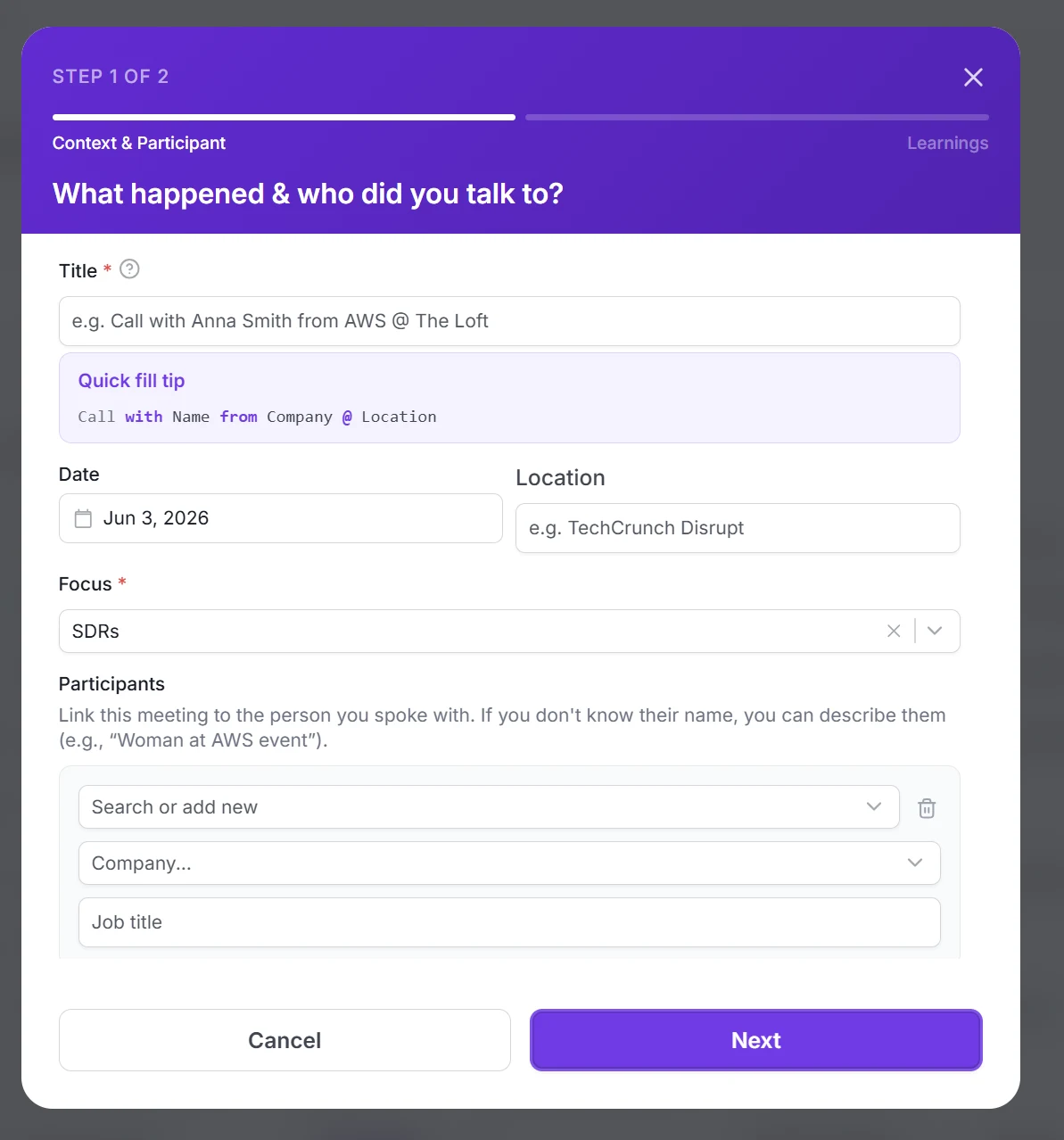
- One key takeaway: What's the single most important thing you learned?
- One surprise: What did you hear that you didn't expect?
- One opportunity: What could you build or change based on this?
This lightweight debrief keeps insights fresh and makes synthesis easier later. (More: The 10-Minute Interview Debrief)
Step 7: Synthesize across interviews
Individual interviews are useful. Patterns across interviews are powerful.
After 8–12 conversations, look for:
- Recurring themes: What pain points or needs came up multiple times?
- Segment differences: Did different types of customers say different things?
- Surprising outliers: What did only one person say that might still matter?
Synthesis methods
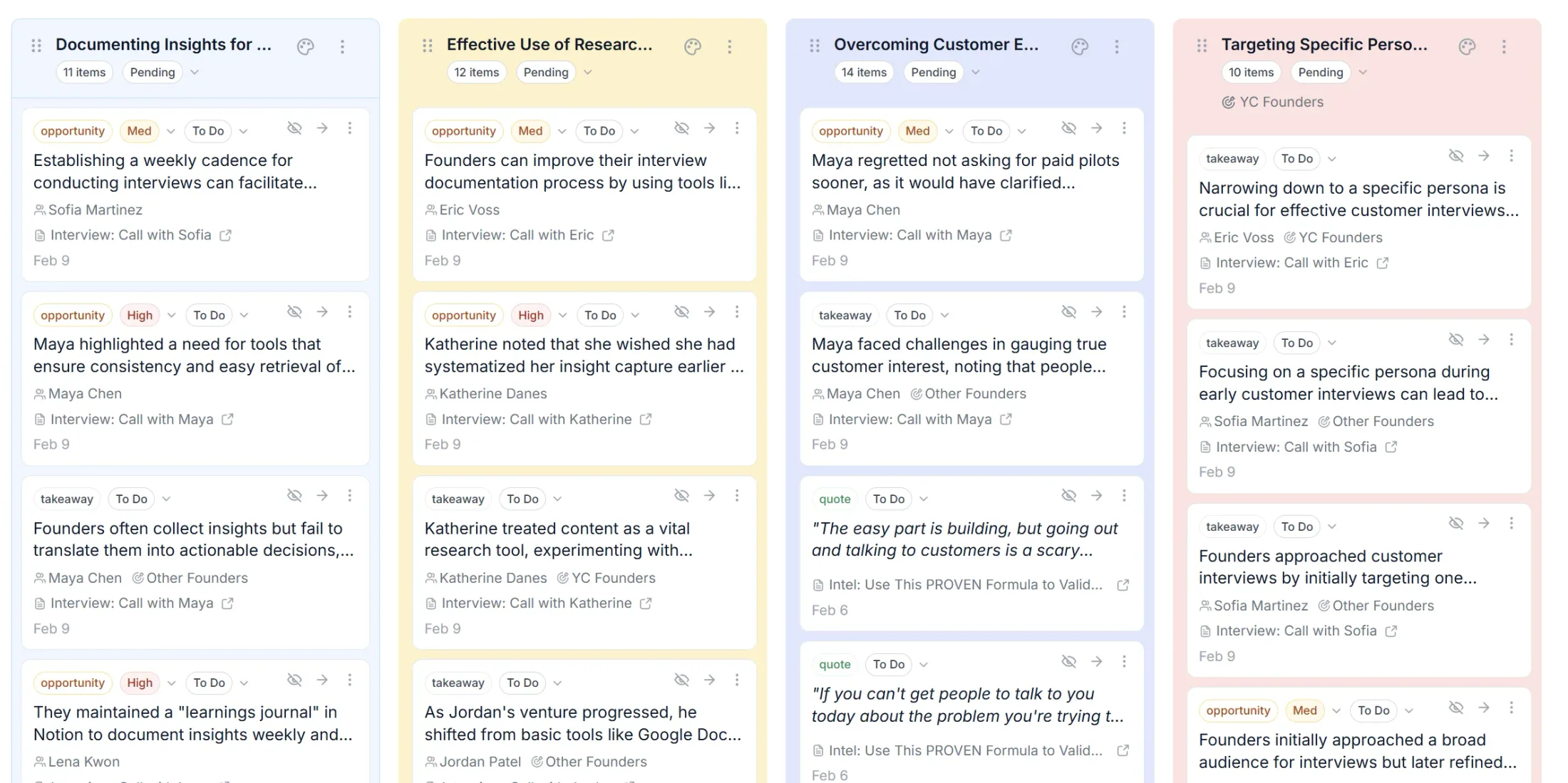
- Affinity mapping: Group similar quotes and insights, then name the clusters.
- AI-assisted synthesis: Tools like Intervool extract insights from each call and cluster them automatically, so you can find patterns across dozens of conversations without re-watching every recording.
The goal isn't a report — it's a decision. What will you build, change, or stop doing based on what you learned?
Common mistakes to avoid
Talking to the wrong people. Five interviews with your target segment beat fifty with random users.
Asking leading questions. "Wouldn't it be better if..." tells you what you want to hear, not what's true.
Not recording. You'll forget the exact words, and the exact words matter.
Skipping the debrief. Insights fade fast. Capture them while they're fresh.
Stopping at the report. Research that doesn't change anything is a waste. Tie insights to decisions.
Tools for customer interviews
The minimum setup is a video call with recording. As you scale, dedicated tools help you capture, organize, and synthesize what you learn.
- Recording & transcription: Zoom, Google Meet, or dedicated tools like Grain or tldv.
- Interview-to-insight platforms: Intervool captures interviews, extracts AI-powered insights, and clusters themes — so research drives decisions instead of sitting in a folder.
- Recruiting: User Interviews, Respondent, or direct outreach.
See our full comparison of customer interview software for more options.
Start with your next conversation
You don't need perfect process to start. Pick one customer, schedule a 30-minute call, prepare 5 questions, and listen. That single conversation will teach you more than weeks of guessing.
Then do it again. And again. The compounding insight from regular customer conversations is the closest thing to a cheat code in product development.