B2B qualitative research is how software and services teams understand the people who buy and use their products — their goals, workflows, and the messy realities of getting a decision made inside an organization. It follows the same principles as consumer research but plays out very differently, because in B2B you're rarely studying one person making a quick personal choice.
What is B2B qualitative research?
B2B qualitative research is the open-ended study of business buyers and users — through interviews, observation, and analysis of the feedback they give — to understand why they choose, adopt, and stay with (or churn from) a product. The output is rich, contextual insight into the buying committee, the jobs to be done, and the friction in real workflows.
How B2B qualitative research differs from consumer research
| B2B | Consumer (B2C) | |
|---|---|---|
| Decision unit | A buying committee (5–10+ stakeholders) | Usually one person |
| Participants | Fewer, harder to reach, higher value | Many, easier to recruit |
| Sales cycle | Long; multiple touchpoints | Short |
| Buyer ≠ user | Often different people | Usually the same |
| Recruiting | Via sales, CS, and your CRM | Panels, intercepts |
| Stakes per interview | Very high — each account matters | Lower per person |
The practical upshot: in B2B you can't brute-force sample size, so who you talk to and how rigorously you synthesize matters more. A handful of the right conversations across the buying committee can outweigh hundreds of shallow responses.
The best B2B qualitative research methods
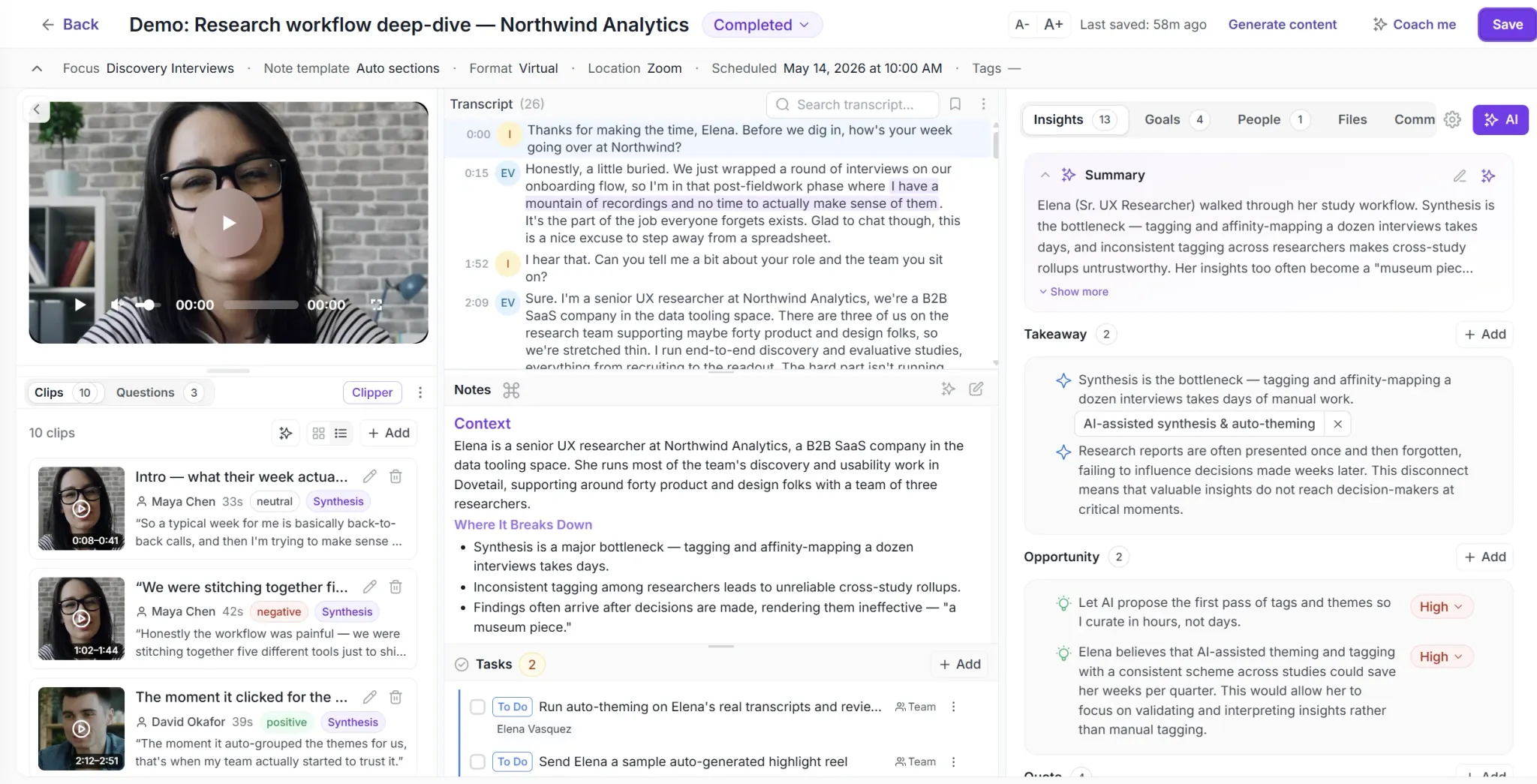
1. Buyer and user interviews. Semi-structured customer interviews are the backbone. Talk to economic buyers, champions, and end users separately — they have different goals and pain points.
2. Win-loss interviews. Talk to deals you won and lost (and churned accounts). Few methods reveal positioning and competitive gaps as sharply as asking why someone chose — or didn't choose — you.
3. Customer advisory boards. Recurring sessions with a curated set of strategic accounts surface roadmap-shaping themes and deepen relationships.
4. Support, sales-call, and CS mining. You already sit on a goldmine of qualitative signal — tickets, call recordings, QBR notes. Analyzing it systematically is research you've already paid to collect.
5. Usability testing and contextual inquiry. Watch real users in their actual workflow and tools. B2B workflows are complex; observation beats self-report.
6. Ride-alongs / job shadowing. Sitting with a user through their day surfaces workarounds and unspoken needs no interview question would.
How to recruit B2B participants
This is the hardest part of B2B research. The unlock is your own funnel:
- Partner with sales and CS. They have the relationships. Make participation easy and low-friction.
- Recruit from your CRM across segments and lifecycle stages — not just your happiest customers.
- Use the buying committee. Ask each participant who else was involved, and talk to them too.
- Offer value, not just incentives. Executives respond to "we'll share what we learn" more than a gift card.
How to analyze B2B qualitative research
- Capture and transcribe every conversation so nothing is lost.
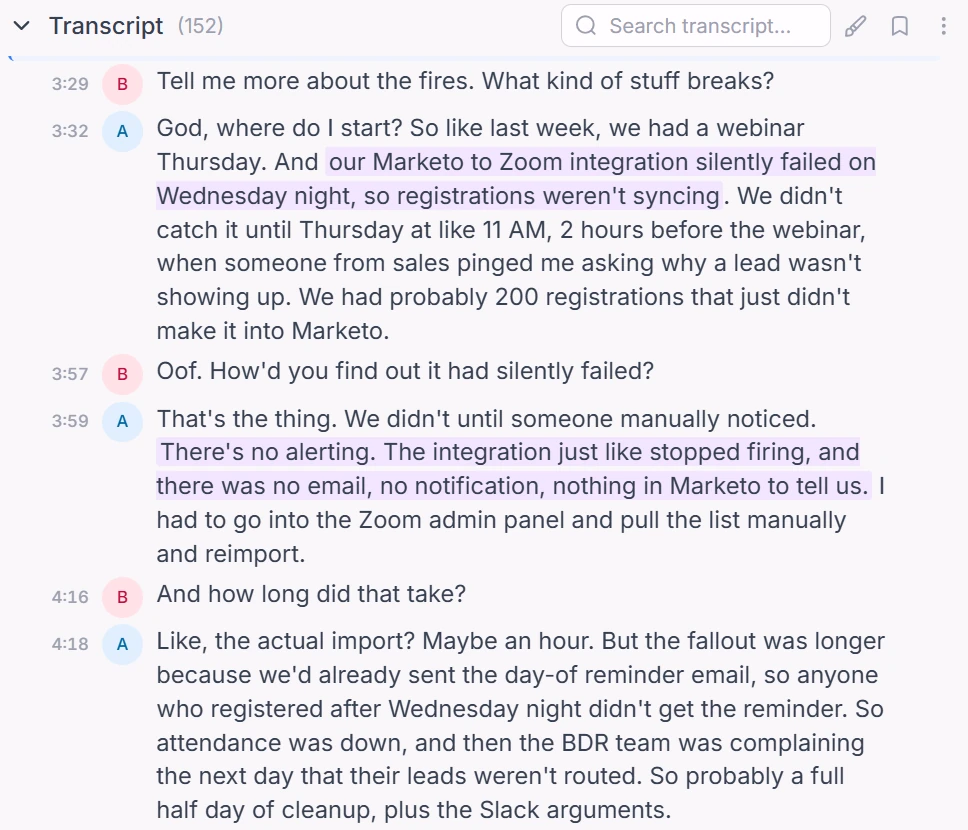
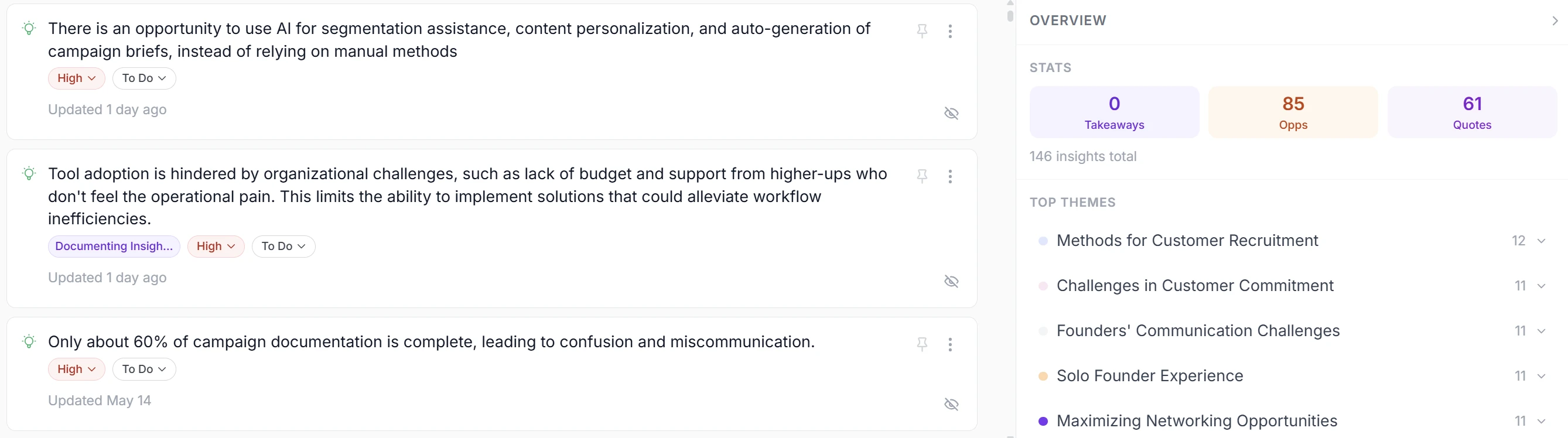
- Extract pain points, opportunities, and quotes, each tagged to the person, role, and account.
- Cluster into themes with thematic synthesis and affinity mapping.
- Segment the patterns — what does the economic buyer care about vs. the end user? Enterprise vs. mid-market?
- Tie themes to revenue. In B2B you can often link a theme to ARR at risk or expansion potential, which sharpens prioritization.
- Distill into decisions — a roadmap and positioning you can defend, each item one click from the quote behind it.
Benefits of B2B qualitative research
- Understand the whole buying committee, not just one voice
- Sharpen positioning with win-loss truth
- Prioritize by real business impact, not the loudest account
- Reduce churn by catching friction early
- Align product, sales, and CS around the same evidence
Best practices
- Talk to buyers and users — they're different.
- Recruit across segments to avoid sampling skew.
- Ask neutral, non-leading questions to limit confirmation bias.
- Interview to saturation (until themes repeat) rather than chasing a number.
- Keep every insight linked to its source so findings stay defensible.
Make B2B research compound
Because B2B conversations are scarce and high-stakes, the cost of losing their insight is high. Intervool is built for exactly this: capture every buyer and user interview, synthesize evidence-linked themes across segments, and carry them into a prioritized roadmap — so a small number of the right conversations drives the whole company. See how it works or start a free trial.