Comparative analysis is the practice of systematically examining two or more things — products, segments, options, time periods, or cases — side by side to understand how and why they differ. It turns "these feel different" into a structured, defensible explanation you can act on.
What is comparative analysis?
Comparative analysis is a method for evaluating multiple subjects against a consistent set of dimensions to surface meaningful similarities and differences. The point isn't just to list contrasts — it's to explain why they exist and what to do about them. Done well, it converts scattered observations into a clear decision.

Why comparative analysis matters
- It forces consistent criteria, reducing gut-feel bias.
- It reveals gaps and opportunities you'd miss looking at one thing in isolation.
- It makes trade-offs explicit, so decisions are defensible.
- It's flexible — it works on qualitative evidence, quantitative data, or both.
Types of comparative analysis
1. Competitive analysis. Comparing your product against competitors across features, positioning, pricing, and experience. (See our customer feedback tools roundup for a worked example of structured comparison.)
2. Feature or option comparison. Weighing build-vs-buy, two designs, or candidate solutions against criteria like impact, effort, and risk.
3. Segment comparison. Comparing what different customer segments or personas need — the heart of good customer research.
4. Temporal comparison. Before/after or period-over-period — did a change move the needle?
5. Qualitative comparative analysis (QCA). A formal social-science method for comparing cases to find which combinations of conditions lead to an outcome.

A step-by-step framework
- Define the question and what a good decision looks like. "Which segment should we build for first?" beats "compare our segments."
- Choose what to compare. Keep the set genuinely comparable.
- Pick consistent dimensions. The same criteria applied to every subject — that consistency is what makes it analysis, not anecdote.
- Gather evidence for each. Pull from interviews, usage data, market research; cite sources so claims are verifiable.
- Build a comparison matrix. Subjects as rows, dimensions as columns. A table exposes patterns instantly.
- Interpret the why. Explain the differences and their implications — the step weak analyses skip.
- Decide and document. State the recommendation, the trade-offs, and what would change your mind.
Example: a comparison matrix
| Dimension | Option A | Option B |
|---|---|---|
| Customer impact | High (cited in most interviews) | Medium |
| Effort to build | Medium | Low |
| Strategic fit | Strong | Weak |
| Risk | Moderate | Low |
A matrix like this — backed by evidence per cell — turns a debate into a prioritization decision in minutes.
Common pitfalls
- Comparing apples to oranges — subjects that aren't truly comparable.
- Cherry-picking dimensions that favor a predetermined answer (confirmation bias).
- Listing without interpreting — a table of differences isn't an analysis until you explain them.
- Unsourced claims — keep each cell traceable to evidence.
How comparative analysis fits customer research
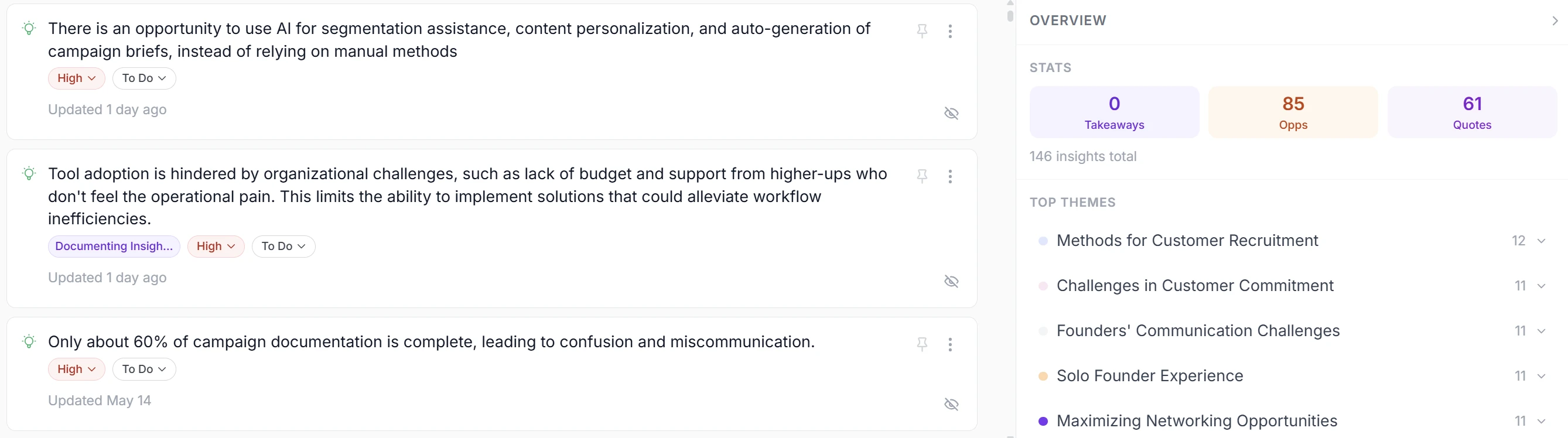
The most valuable comparisons in product work are between what different customers need. Comparing segments and personas — built from real interviews — is how you decide who to build for and why. Intervool makes this practical: it synthesizes interviews into evidence-linked themes you can compare across segments, each one click from the customer quote behind it. See how it works or start a free trial.