A semi-structured interview is a conversation with a plan. You go in with a short list of open-ended questions you need answered, you ask them in whatever order the conversation makes natural, and you follow the interesting answers wherever they lead. It is the default format for customer and user interviews because it gets you both things you want from a research conversation: comparable answers across people, and the surprises no script would have predicted.
This guide covers what separates semi-structured interviews from the alternatives, when to choose one, how to write the interview guide, how to run the session, and how to analyze what you get back — with an example question set you can adapt.
What is a semi-structured interview?
A semi-structured interview uses an interview guide — typically 6–12 open-ended questions grouped by topic — rather than a fixed script. The interviewer covers every topic in the guide with every participant, but is free to reorder questions, rephrase them, skip ones that have already been answered, and add follow-up probes ("why was that?", "what happened next?") on the spot.
The format sits between the two extremes:
- Structured interviews ask every participant the same questions in the same words in the same order, usually with closed answers. They are really surveys delivered by voice: highly comparable, easy to analyze, and unable to learn anything you didn't already think to ask.
- Unstructured interviews have a topic and nothing else. They produce rich, unexpected material and are nearly impossible to compare across participants, which makes them slow to analyze and easy to misread.
- Semi-structured interviews keep the topics fixed and the path flexible. You can compare answers to the same question across ten people and chase the thing the third person said that nobody else mentioned.
When to use a semi-structured interview
Use one when you know what you need to learn about but not what the answers will be. That describes most product research:
- Customer discovery — you know the problem area; you don't know how people experience it or what they do about it today.
- Jobs-to-be-done and switching research — you know the decision you want reconstructed; the story is theirs.
- Post-usability-test debriefs — you know which tasks were hard; you need to know why.
- Churn and win-loss interviews — you know the outcome; the causes are the point.
- Persona and segment research — you need comparable answers across many people, plus the texture that makes a persona real.
Reach for a structured interview (or a survey) when you need counts from a large sample and already know the answer space. Reach for an unstructured interview only in the earliest exploration, when you genuinely don't know what the topic contains yet.
How to write a semi-structured interview guide
The guide is the whole method, so it deserves an hour.
- Start from the decision. Write down the decision this research informs and the two or three things you'd need to know to make it. Every question should trace back to one of those.
- Write topics, then questions. Group the guide into 3–5 topics in the order a natural conversation would move through them — usually context → current behavior → problems → attempted solutions → wrap-up.
- Make every question open and past-tense. "Walk me through the last time you…" beats "How do you usually…", which beats "Would you…". Specific past events are remembered accurately; habits and hypotheticals are invented on the spot.
- Write the probes in advance. Under each question, list the two or three follow-ups you'll use if the answer is thin: "What did you do next?", "Who else was involved?", "What did that cost you?". Having them written down frees you to listen instead of composing.
- Cut it to 45 minutes. Six to ten main questions is plenty. If the guide runs longer, you are asking a survey's worth of questions and will get a survey's depth.
- Pilot it once. Run it on a colleague or a friendly customer and cut whatever produced a shrug.
Example semi-structured interview questions
A guide for a discovery interview about a team's reporting workflow might look like this:
Context
- What does your role involve day to day?
- Where does reporting fit into your week?
Current behavior
- Walk me through the last report you put together, start to finish.
- Which tools were involved, and where did the data come from?
Problems
- What was the most frustrating part of that?
- The last time it went wrong, what happened, and what did you do?
- How often does that come up?
Attempted solutions
- Have you tried anything to fix it? What happened?
- What would have to be true for you to change how you do this?
Wrap-up
- What should I have asked that I didn't?
- Who else deals with this that I should talk to?
That is eleven questions and it will fill 40 minutes with the probes. Our free customer interview template has a fuller set in the same shape, and the customer discovery and jobs-to-be-done templates adapt it for those specific studies.
How to run the interview
- Record it and say so. Ask permission at the start. Recording means you can look at the person instead of your notes, and it is the raw material for everything after.
- Ask, then stop talking. The best answers arrive after the pause you were tempted to fill.
- Follow the energy. When someone's tone changes — a sigh, a laugh, a "honestly…" — that is where the insight is. Leave the guide and go there; you can come back.
- Don't pitch, don't lead. "Would something like X help?" ends the useful part of the interview. If you must test a concept, do it in the last five minutes, after you've heard the unprompted version.
- Close every topic before moving on. A quick "anything else about that?" costs ten seconds and often gets the most candid answer of the session.
How to analyze semi-structured interviews
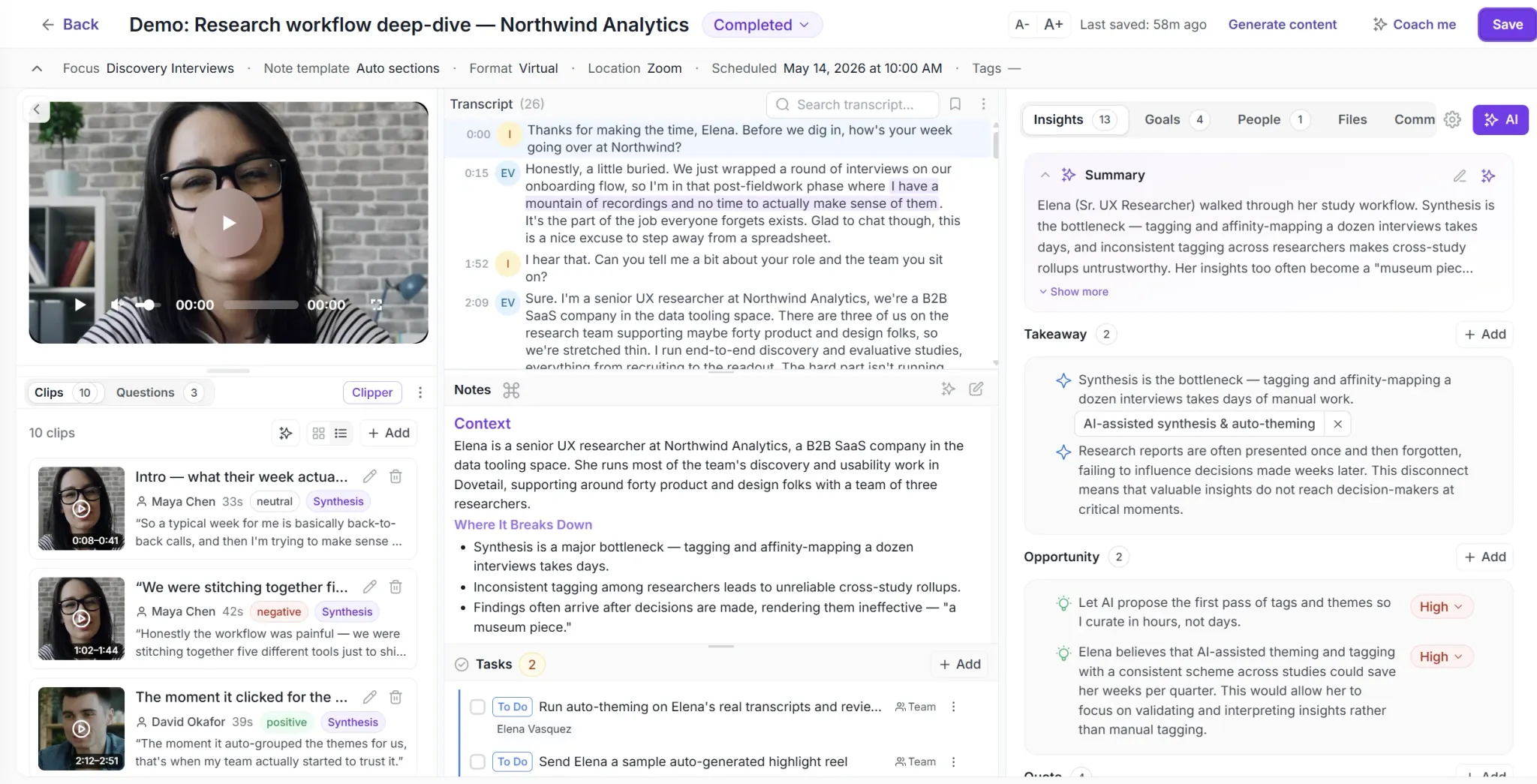
Because the topics are fixed, analysis can be systematic even though the conversations weren't. The standard approach is thematic:
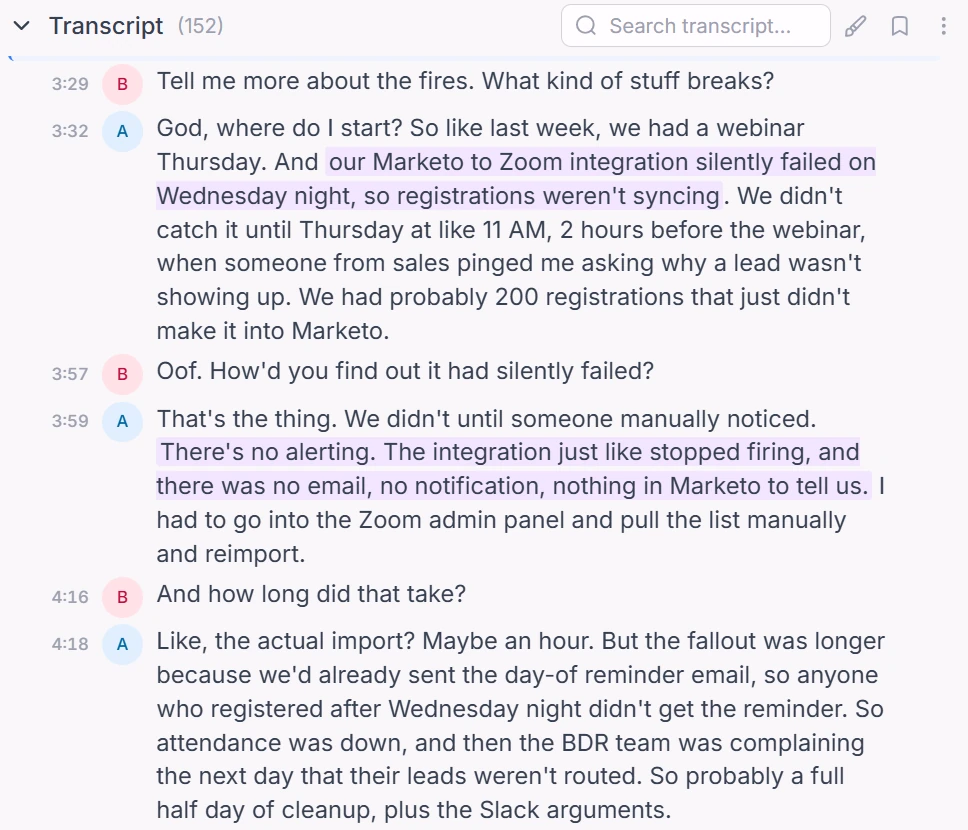
- Transcribe every interview so quotes are searchable and exact. (See how to transcribe an interview.)
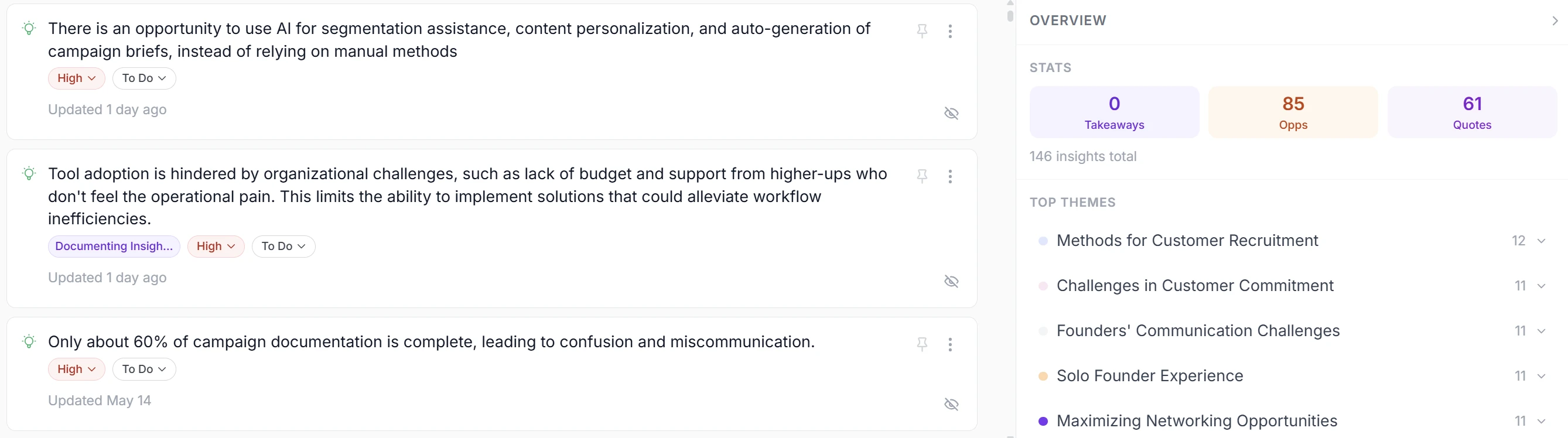
- Code the transcripts — tag the moments that matter: a pain point, a workaround, a request, a surprising quote — keeping each tag linked to the line it came from.
- Group codes into themes across interviews. "Rebuilds the same report weekly" from five different people is a theme; a single mention is a note.
- Weigh the themes by how many people raised them, how strongly, and from which segment.
- Write each theme as a decision-ready sentence with its evidence count, and carry the ones that matter into prioritization.
The full method, with a worked example on a real transcript, is in how to analyze customer interviews. If you run more than a handful of these, tools that do the coding and grouping for you — and keep every theme linked to the quote behind it — pay for themselves fast; that is what Intervool is built to do for customer and user interviews.
Semi-structured interviews: strengths and limits
Strengths. Comparable across participants; open to surprise; natural for the participant; the interviewer's judgment is a feature, not a bug.
Limits. They depend on the interviewer — a weak interviewer with a good guide still gets thin answers. Sample sizes are small, so they tell you what is true and common in the people you spoke to, not how common it is in the population. And they take real time to analyze: an hour of interview is comfortably an hour of analysis without help.
None of those are reasons not to use them. They are reasons to write a good guide, record everything, and get the analysis off your plate.